
Here are 4 articles about coffee-related topics that I generated using different LLM APIs. I did this to compare costs and quality of different models in a practical application.
You can see the whole story on YouTube.
First, here are the costs of all this fun:
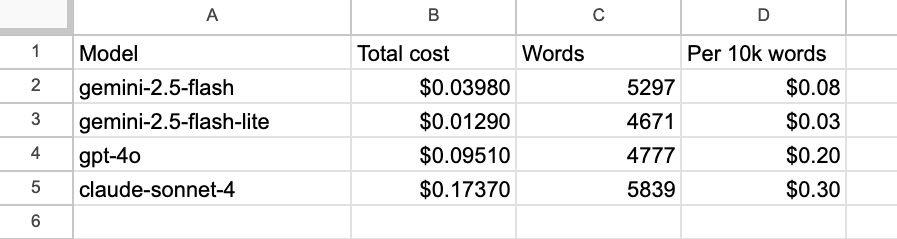
Here are the individual articles from cheapest to most expensive (the topic, headline and outline were all the same):
by gemini-2.5-flash-lite
# Roast levels explained: light, medium, dark and what they mean for taste

Ever wondered why some coffee beans taste like sunshine and berries, while others hit you with a bold, smoky punch? It's not magic, though I sometimes wish it was! It's all about the incredible journey those humble green beans take during the roasting process. Forget everything you _think_ you know, because we're about to dive deep into the delicious science of coffee roasting. You'll discover exactly how heat transforms beans into the complex flavors we crave, from the delicate dance of floral notes in a light roast to the rich, caramelized depths of a dark one. Prepare to unlock a whole new level of appreciation for your morning cup, understand _why_ your favorite coffee tastes the way it does, and even learn how to talk about it with your barista like a seasoned pro. Ready to explore?

The Coffee Roasting Process
---------------------------

Roasting is where green coffee beans truly come alive, transforming them from hard, grassy seeds into the aromatic, flavorful beans we know and love. It’s a fascinating process that involves heat, time, and a bit of science.

### How Green Coffee Beans Transform During Roasting

Imagine starting with small, dense, green pebbles. That’s essentially what green coffee beans are. When exposed to heat, these beans undergo a series of dramatic changes. They start to turn yellow, emit a grassy aroma, and then, as the temperature rises, they begin to brown. During this browning, they expand in size, lose some of their moisture, and their density decreases. The beans also start to release oils, which can become more visible on the surface as the roast progresses.

### The Science Behind the Maillard Reaction

At the heart of this transformation is a chemical process called the Maillard reaction. This isn't just about browning; it's about creating hundreds of new flavor compounds. The Maillard reaction happens when amino acids and sugars in the coffee bean are heated. It’s the same reaction that gives bread its crust and caramelizes sugar. In coffee, it’s responsible for developing those nutty, toasty, chocolatey, and caramel notes that we find so appealing.

### Key Physical Changes: First Crack, Second Crack

As the beans heat up, they start to pop. This is known as "first crack." It’s a physical sign that the internal pressure from steam and gases has built up enough to break the bean’s cellular structure. First crack sounds like popping popcorn, and it usually happens around 385-400°F (196-204°C).

{Here, you'll discuss what happens _during_ first crack and _immediately after_. Think about the visual changes and the release of aromas. Think about the sensory experience for someone witnessing it.}

Shortly after first crack, the beans enter a more delicate phase. If you continue to roast them, you'll eventually hear "second crack." This popping sound is quieter and more rapid than first crack, and it indicates that the bean's cell walls are starting to rupture further, releasing more oils and sugars. Second crack usually occurs around 435-455°F (224-235°C). This is a critical point, as going much beyond second crack can lead to burning.

### Chemical Transformations at Different Temperatures

Beyond the physical changes, a lot is happening chemically. As the temperature climbs, the sugars in the bean caramelize, contributing sweetness and body. Acids that were present in the green bean can break down, impacting the coffee's brightness and acidity. Volatile aromatic compounds, responsible for the coffee's aroma, are created through both the Maillard reaction and caramelization. The specific balance and intensity of these compounds are what ultimately determine the coffee's flavor profile and are directly influenced by the roast level.

Light Roast Coffee
------------------

### What to Look For

When I talk about light roasts, I'm referring to beans that have been roasted for the shortest amount of time and at the lowest temperatures, typically between 356°F and 401°F (180°C and 205°C). You'll notice they retain their original color much more than darker roasts. They’ll be light brown, perhaps a tan color, and feel dry to the touch – no oily sheen here. Their density is usually higher, and because they are roasted less, they tend to have more caffeine than darker roasts.

### The Taste Experience

For those who appreciate bright, vibrant flavors, light roasts are a real treat. The lower roasting temperatures preserve many of the delicate floral and fruity notes inherent to the coffee bean’s origin. You'll often find a pronounced acidity, which can taste like citrus or berries, adding a lively zing to your cup. These coffees really let the nuances of where they were grown shine through.

### Brewing for the Best

Because of their delicate flavors and higher acidity, light roasts often pair best with brewing methods that highlight these characteristics. Pour-over methods like a V60 or Chemex are fantastic because they allow for precise control over water temperature and flow rate, really bringing out those complex aromas and flavors. Espresso can also work, but be mindful that the brightness might come across quite intensely.

### Origins That Pop

Certain coffee origins truly excel when given a light roast. Coffees from East Africa, like Ethiopia or Kenya, are famous for their bright acidity and complex fruity and floral notes, which are beautifully preserved by lighter roasting. Similarly, some Central American coffees, particularly those from Guatemala or Costa Rica, can offer delightful citrusy or even chocolatey undertones that a light roast really brings to the forefront.

Medium Roast Coffee
-------------------

Medium roasts fall into a temperature range typically between 410°F and 428°F (210°C to 220°C). At this stage, you'll notice the beans take on a uniform medium brown color. Unlike lighter roasts, they might start to show a very slight sheen, but they generally remain dry to the touch. The beans have expanded in size and lost some of their original density.

### Flavor Profile

This is where things get really interesting. Medium roasts offer a fantastic balance. You’ll find a heightened sweetness compared to light roasts, often with noticeable caramelization. Chocolatey notes are common, ranging from milk chocolate to darker cocoa undertones. The acidity, which is bright in light roasts, mellows out considerably, becoming more balanced and less sharp. You can expect a pleasant, well-rounded flavor that bridges the gap between the origin characteristics of light roasts and the bolder flavors of dark roasts.

### Body and Mouthfeel

The body of coffee refers to how it feels in your mouth – its weight and texture. Medium roasts usually provide a medium body. This means they have a pleasant, not-too-light, not-too-heavy feel on your palate. The mouthfeel is often smooth and satisfying, without the sometimes thin sensation of very light roasts or the sometimes full, heavy feel of dark roasts.

### Versatility in Brewing

This balanced profile makes medium roasts incredibly versatile. They perform exceptionally well across a wide range of brewing methods. Whether you enjoy a pour-over, a French press, or even an espresso, a medium roast is likely to deliver a delicious cup. Its inherent sweetness and moderate acidity mean it can stand up to different brewing techniques without becoming overwhelmingly bitter or unpleasantly sour.

### Popular Medium Roast Varieties

Many origins shine with a medium roast. Coffees from Colombia, Brazil, and Honduras are often excellent choices for this roast level. They tend to develop rich nutty or chocolatey notes and a pleasing caramel sweetness when roasted to medium, making them crowd-pleasers for many coffee drinkers.

Dark Roast Coffee
-----------------

Dark roast coffees are the result of roasting beans at higher temperatures, typically between 430°F and 465°F (221°C to 240°C). As the beans reach these temperatures, they undergo significant transformation. Their color deepens to a rich, dark brown, and the surface becomes visibly oily. This oil development happens because the cell structure of the bean breaks down further, releasing natural oils. You might hear crackling sounds or see wisps of smoke as the sugars and compounds within the bean continue to break down.

### Flavor Profile and Characteristics

When you brew a dark roast, expect a bold and intense flavor. The long exposure to heat creates a distinct smoky character and a pronounced caramelized sweetness. The original fruity or floral notes of the coffee bean are often overshadowed by the roast’s intensity. Acidity is significantly reduced, giving way to a heavier body and a smooth, sometimes even slightly bitter, finish. Think notes of dark chocolate, toffee, and a pleasant toastiness.

### Debunking Caffeine Myths

A common misconception is that dark roasts have more caffeine than lighter roasts. In reality, the opposite is often true. While the roasting process itself doesn't significantly destroy caffeine, the longer and hotter the roast, the more the bean is roasted away. This means that by volume, a scoop of dark roast beans will contain slightly less caffeine because they are less dense and have lost more mass during the roasting process. However, if you measure your coffee by weight, the caffeine content is more similar across roast levels.

### Traditional Applications

Dark roasts have long been favored for certain brewing methods and regions. Their bold flavor stands up well to milk and sugar, making them a popular choice for espresso drinks like lattes and cappuccinos, where the coffee needs to cut through those additions. Historically, dark roasts were also very common in many European countries, particularly in Italy, where espresso culture took hold and the robust flavors were highly sought after.

How Roast Levels Affect Specific Flavor Compounds
-------------------------------------------------

As we roast coffee beans, we’re not just changing their color; we’re dramatically altering the chemical compounds that create all the flavors and aromas you detect in your cup. Each roast level, from light to dark, plays a crucial role in how these compounds develop, transform, or even disappear.

### Acids: From Brightness to Smoothness

Acids are a big reason coffee has that pleasant tanginess or brightness. In green coffee beans, you find acids like chlorogenic acid, which is abundant. As you roast, chlorogenic acid starts to break down.

*   **Light Roasts:** These keep most of their chlorogenic acids. This is why light roasts often have a bright, sharp acidity, sometimes described as citric or even wine-like. You might notice flavors that remind you of fruit or flowers.
*   **Medium Roasts:** Here, some chlorogenic acid has broken down, turning into other acids like quinic acid. Quinic acid can contribute to a more mellow, sometimes slightly bitter or tart taste as the roast progresses. The acidity is still present but usually smoother.
*   **Dark Roasts:** By the time you reach dark roasts, most of the chlorogenic acid is gone. The remaining acids, often quinic acid, can contribute to a more dominant bitterness if the roast is pushed too far. The bright, fruity notes are replaced by darker, often bolder flavors.

### Sugars: The Sweet Transformation

Sugars are essential for creating sweetness and those delicious caramelization notes.

*   **Light Roasts:** While sugars are present, they mostly remain as simpler sugars. You won't find much caramelization, which leads to less pronounced sweetness and a more natural, raw sugar taste.
*   **Medium Roasts:** This is where sugars really start to shine. The heat causes sugars to caramelize, leading to a noticeable increase in sweetness. Think of flavors like caramel, chocolate, and nutty notes. The more sugars caramelize, the more balanced and sweet the coffee becomes.
*   **Dark Roasts:** Sugars continue to caramelize and then start to break down further. This can lead to deeper, richer sweetness, almost like burnt sugar or dark toffee. However, if roasted too long, the sugars can burn, resulting in a bitter, ashy taste that masks any original sweetness.

### Aromatics: The Fragrant Journey

The complex aromas in coffee come from hundreds of volatile compounds, and roasting greatly impacts these.

*   **Light Roasts:** These beans tend to preserve many of the original aromatic compounds from the green bean. This is why you often get delicate floral or fruity aromas that are very distinct and can be quite complex.
*   **Medium Roasts:** As roasting continues, new aromatic compounds are created through reactions like the Maillard reaction. These new compounds often contribute to toasted, nutty, or chocolatey aromas, complementing and sometimes overshadowing the lighter, floral notes.
*   **Dark Roasts:** High temperatures cause a breakdown of many aromatic compounds, both original and newly formed. While some desirable smoky or toasty aromatics develop, many of the subtler, nuanced aromas are lost. The intense heat can also create less pleasant smoky or burnt smells.

### Body: The Feel in Your Mouth

The "body" of coffee refers to how it feels in your mouth – its weight, texture, and richness. This is influenced by proteins and fats in the bean.

*   **Light Roasts:** Beans remain denser, and proteins and fats are largely intact. This often results in a lighter body, which can feel thinner or more crisp.
*   **Medium Roasts:** The roasting process starts to break down some cell structures. Fats and proteins begin to transform, contributing to a fuller, more rounded body and a smoother mouthfeel. This is often described as having more substance.
*   **Dark Roasts:** The intense heat significantly breaks down the cell walls, releasing oils to the surface. This transformation creates a heavier, richer body and a more viscous or syrupy mouthfeel. The oils contribute to a rounder, often bolder sensation on the palate.

Choosing the Right Roast for Your Palate
----------------------------------------

Now that you understand how different roast levels transform coffee beans, the exciting part is finding what you love. It's all about exploring your personal taste, and I find that paying attention to a few key sensory details can really help you pinpoint your favorite roast.

### Tasting Tips for Identifying Roast Levels

When you're tasting coffee, start by looking at the beans themselves. As we've discussed, light roasts are a light brown and dry, medium roasts are a more uniform medium brown, sometimes with a slight sheen, and dark roasts are dark brown and noticeably oily. Your sense of smell is your next best friend. A light roast might greet you with delicate floral or fruity aromas. As you move to medium roasts, you'll start to pick up on notes of nuts, caramel, and perhaps some chocolate. Dark roasts tend to have bolder, sometimes smoky or toasty scents, and you might lose some of those subtler fruity notes you'd find in a lighter roast.

When you take a sip, pay attention to the acidity, body, and the overall flavor profile. Light roasts often have a bright, lively acidity and a lighter body, highlighting nuances in flavor. Medium roasts offer a balance – the acidity is mellowed, the body is more substantial, and you'll taste those pleasant caramel and chocolate notes more prominently. Dark roasts usually have low acidity, a heavier body, and bolder flavors like dark chocolate or even burnt sugar. Don't be afraid to take small sips and really focus on what you're experiencing.

### Pairing Roast Levels with Milk, Sugar, and Other Additives

The roast level you choose can really influence how it interacts with milk, sugar, and other additions. I find that light roasts, with their bright acidity and delicate flavors, can sometimes be overwhelmed by milk or a lot of sugar. Their vibrant notes are best appreciated on their own or with just a touch of sweetness to enhance, not mask, their character.

Medium roasts are often the sweet spot for many. Their balanced flavor profile, with enhanced sweetness and those lovely caramel or chocolate notes, holds up beautifully to milk and sugar. They offer a comforting richness that pairs well with these additions.

Dark roasts, with their bold and often smoky flavors, are famously robust. They stand up incredibly well to milk and sugar, with the additions complementing their intense profiles, often creating a rich, dessert-like experience. If you enjoy a strong, classic coffee flavor, especially in drinks like lattes or cappuccinos, dark roasts are often a great choice.

### How to Communicate Your Roast Preferences to Baristas

When you’re at a coffee shop, knowing how to tell the barista what you like can make all the difference. Instead of just saying "give me coffee," you can be more specific! I’ve learned to describe the flavors I’m looking for. You could say something like, "I prefer coffee with fruity and floral notes," which usually points towards a light roast. Or perhaps, "I like something smooth and balanced with chocolate or caramel flavors," suggesting a medium roast. If you enjoy a bold, intense cup, you might ask, "Do you have anything with a darker roast that would be good for a strong espresso?"

You can also talk about the body or how the coffee feels in your mouth. Mentioning if you like a "lighter, crisper feel" or a "heavier, richer feel" can further guide them. Don't hesitate to ask them for recommendations based on your descriptions. Most baristas are passionate about coffee and love helping customers find their perfect cup.

### Exploring Your Taste Preferences Across the Roast Spectrum

Ultimately, the best way to find your favorite roast is through tasting and experimenting. I encourage you to try coffees from different origins at each roast level. You might discover that you love Ethiopian coffees as a light roast, but prefer Brazilian beans as a medium roast. Or perhaps you’ll find a dark roast from Sumatra that becomes your go-to. Think of it as a delicious journey! Keep a small journal, jotting down what you liked or didn't like about each coffee, the roast level, and maybe even the origin. This way, you’ll build a clear picture of your evolving palate and become a more confident coffee explorer.

The Roaster's Craft
-------------------

To understand coffee truly, you need to appreciate the artistry of the roaster. It's not just about throwing beans into a machine; it's a delicate dance with temperature and time, aiming to unlock the unique potential within each bean. A skilled roaster, much like a chef, knows that the origin of the bean, its processing method, and even the weather during its growth can influence how it will behave in the roaster. They are constantly making decisions, adjusting their technique to bring out the best possible flavors.

### Single-Origin vs. Blend Roasting

When a roaster decides to roast beans from a single origin, their goal is often to showcase the distinct characteristics of that specific place – be it the floral notes of an Ethiopian Yirgacheffe or the nutty sweetness of a Brazilian Cerrado. They'll typically aim for lighter to medium roasts to preserve these delicate, inherent flavors.

With blends, the roaster has a different kind of canvas. They're not necessarily trying to highlight just one origin's traits. Instead, they're combining beans from different regions, each with its own strengths, to create a new, harmonious flavor profile. A roaster might use a bean with bright acidity in one part of the blend and another with a heavy body in another, carefully selecting roast levels for each component to ensure they complement each other perfectly. The final roast level for a blend is chosen to best express the intended overall character of the mixture. For instance, to create a balanced espresso blend, a roaster might combine an acidic component roasted lighter with a more full-bodied bean roasted darker, with the final blend often falling into the medium roast category.

### Regional Roasting Traditions

There's a fascinating diversity in how coffee is roasted around the world, shaped by history, culture, and what consumers prefer.

*   **Italy:** Think of Italian coffee culture, and you probably picture dark, intense espresso. Traditionally, Italian roasters have favored very dark roasts. They aim to bring out bold, smoky flavors and a rich, oily sheen, often masking the subtler nuances of the bean in favor of a strong, consistent profile that stands up well to milk and sugar.
*   **Scandinavia:** In contrast, Scandinavian countries are famous for their appreciation of lighter roasts. Here, the focus is on preserving the bright acidity and delicate fruity and floral notes that many beans possess. This approach highlights the unique terroir or origin characteristics of the coffee, and you'll often find these countries at the forefront of specialty coffee.
*   **United States:** The US, particularly the specialty coffee scene, has a broad spectrum. While dark roasts were historically dominant, there's been a significant shift towards lighter and medium roasts over the past few decades. Roasters often experiment with different roast profiles to highlight origin characteristics, leading to a wide variety of approaches depending on the roaster and their philosophy.

### Modern Approaches to Roast Profiling

Today, roasters have access to sophisticated tools and a deeper understanding of coffee chemistry than ever before. This has led to the development of "roast profiling."

Roast profiling involves meticulously mapping the temperature changes and airflow within the roaster over the course of a roast. Modern roasters use software to record and analyze these "roast curves." This data allows them to:

*   **Reproduce Roasts:** Once they find a roast curve that produces a fantastic cup, they can replicate it with remarkable consistency.
*   **Analyze and Adjust:** If a batch doesn't turn out as expected, they can review the roast curve to pinpoint where things might have gone wrong and make adjustments for the next roast.
*   **Experiment Intelligently:** Roasters can systematically alter specific parts of the roast curve – like the rate of temperature rise or the duration at certain points – to see how those changes impact the final flavor. For example, a roaster might experiment with extending the "Drying Phase" of a roast to see if it develops more sweetness, or shorten the "Development Time" after the first crack to preserve brighter acidity.

This scientific approach, combined with the roaster's sensory expertise, allows for incredibly precise control over the final taste and aroma of the coffee.

Storage and Freshness Considerations by Roast Level
---------------------------------------------------

As you've probably guessed, how coffee beans are roasted significantly impacts how they age and what the best ways are to keep them fresh. Understanding these differences will help you make sure every cup you brew is as delicious as the first.

### How Different Roast Levels Age Differently

All roasted coffee beans start to lose their peak flavor soon after roasting. The gases that contribute to aroma and flavor, primarily carbon dioxide trapped within the bean, slowly escape. However, the rate at which this happens and the resulting changes vary by roast level.

*   **Light Roasts:** These beans tend to age gracefully. Because they retain more of their original structure and natural oils are less exposed, they can maintain their vibrant acidity and delicate fruity or floral notes for a longer period. You'll find that their complexity diminishes gradually, rather than changing drastically.

*   **Medium Roasts:** Medium roasted beans are in a bit of a sweet spot. They’ve developed more complex flavors through caramelization but haven't broken down as much as dark roasts. They tend to hold onto their balanced sweetness and body for a decent amount of time, though their brighter notes might fade a bit faster than in light roasts.

*   **Dark Roasts:** These are the most delicate when it comes to aging. The high temperatures break down the bean's structure, releasing oils and significantly altering the chemical compounds. This means they lose their nuance and develop more pronounced "roasty" or even slightly bitter notes much quicker. Their freshness is often measured by how long they _don't_ taste stale or burnt.

### Optimal Storage Methods by Roast Type

While the core principles of coffee storage remain the same – keeping it away from air, moisture, heat, and light – there are subtle nuances based on roast level:

*   **General Best Practice:** Always store whole beans in an airtight container. Avoid the refrigerator or freezer unless you plan to store beans for a very long time (months) and are prepared to manage condensation issues upon removal. Room temperature in a dark cupboard is usually ideal.

*   **Light Roasts:** Because these beans are less oily, they are a bit more forgiving. Any good airtight container will serve them well. The key is to minimize air exposure to preserve those volatile aromatic compounds.

*   **Medium Roasts:** Similar to light roasts, airtight storage is crucial. You’re aiming to protect the balance of developed sweetness and acidity.

*   **Dark Roasts:** Given their oily surface, it's especially important to ensure your airtight container is completely dry. The oils on dark roasted beans can degrade and contribute to off-flavors more quickly if exposed to air and moisture. Some people find that a container with a good seal is even more critical for dark roasts to prevent them from picking up external odors.

### Signs of Freshness Across Different Roast Levels

Knowing what to look for will help you pick up the freshest beans:

*   **Appearance:**

    *   **Light Roasts:** Should look uniformly light to medium brown and be dry to the touch, with no oily sheen.
    *   **Medium Roasts:** Will have a medium brown color, possibly with a very slight sheen, but generally still dry.
    *   **Dark Roasts:** Expected to be dark brown with a noticeable, sometimes even glossy, oily surface. If they look "dusty" or have a dull sheen, they might be a bit past their best.
*   **Aroma:**

    *   **Light Roasts:** Should smell bright, often with floral or fruity notes. A lack of aroma or a flat, papery smell is a sign of age.
    *   **Medium Roasts:** Will have a more rounded, toasty, or slightly caramel/chocolate-like aroma. A stale aroma here would be muted and lack that developed sweetness.
    *   **Dark Roasts:** Their aroma will be bold, smoky, or like dark chocolate and toffee. If the aroma is acrid, burnt, or simply gone, they are likely stale.
*   **Taste:** This is the ultimate test. Fresher coffee will have brighter or more defined flavors according to its roast level. Stale coffee, regardless of roast, can taste bland, papery, or develop an unpleasant sourness or bitterness that isn't characteristic of the roast itself.

### Shelf Life Expectations

The "best by" date or roast date is your best friend here. Generally, you want to consume whole bean coffee within a month or so of the _roast date_ for optimal flavor.

*   **Light Roasts:** Often peak about 5-14 days after roasting and can remain good for 3-6 weeks.
*   **Medium Roasts:** Typically peak around 7-21 days after roasting and can be good for 2-5 weeks.
*   **Dark Roasts:** Can taste good shortly after roasting, maybe peaking within 3-10 days, but their quality declines more rapidly, often becoming less enjoyable after 2-4 weeks.

Remember, these are general guidelines. Your own palate is the final judge. Don't be afraid to experiment and see when _you_ think each roast level tastes best!

Unveiling the Spectrum of Coffee Roasts
---------------------------------------

I've explored the fascinating journey of coffee beans from their green state to the various shades of roasted perfection. We delved into the science behind the transformation, uncovering how heat triggers reactions like the Maillard reaction and leads to physical changes such as the first and second cracks. I explained how these processes, happening at different temperatures, cause significant chemical shifts within the beans.

My exploration then focused on the distinct characteristics of each roast level. For light roasts, I described their delicate temperature range, resulting in bright acidity and nuanced floral and fruit notes, and noted their higher bean density and caffeine potential, suggesting that certain origins truly shine with this treatment. Moving to medium roasts, I highlighted their balanced sweetness, hints of chocolate, and moderate acidity, emphasizing their versatility in various brewing methods. Finally, for dark roasts, I detailed their bold, smoky profile with caramelized sweetness, the visible oil on the bean surface, and clarified common misconceptions about their caffeine content.

I also investigated how roast levels specifically influence key flavor compounds, examining the behavior of acids like chlorogenic and quinic, the development of sugars through caramelization, the creation and preservation of aromatic volatile compounds, and the transformation of proteins and fats that contribute to body. This led to a discussion on how you, the reader, can choose the right roast for your palate, providing tasting tips and advice on pairing roasts with milk, sugar, and how to best communicate your preferences to baristas. I touched upon the roaster's craft, discussing how skilled individuals determine roast levels for single-origin beans versus blends, touching on regional traditions and modern profiling techniques. Lastly, I covered how different roast levels age, offering guidance on optimal storage and signs of freshness for each type.

What are your favorite roast levels, and why? Share your thoughts in the comments below!by gemini-2.5-flash
# Roast levels explained: light, medium, dark and what they mean for taste

Picture this: You walk into a coffee shop, scan the menu, and freeze. Light roast Ethiopian, medium roast Colombian, dark roast French—suddenly You realize You have no idea what any of this actually means for Your cup. You're not alone in this coffee confusion, and I've been exactly where You are.

Most coffee lovers think roast levels are just about strength or bitterness. That assumption couldn't be more wrong. The temperature at which coffee beans are roasted literally rewrites their chemical DNA, creating entirely different beverages from the same origin. A light roast Ethiopian coffee tastes nothing like its dark roast counterpart—they're as different as wine and whiskey.

I've spent years exploring how heat transforms humble green coffee beans into the complex flavors we crave. The science behind these transformations reads like a chemistry textbook, but the practical impact on Your daily cup is surprisingly straightforward once You understand the basics.

In this post, I'll walk You through the complete roasting spectrum and decode what each level actually delivers to Your palate. You'll discover why some coffee beans sing at light roasts while others demand the bold treatment of a dark roast, how to match roast levels with Your brewing method for maximum flavor, and most importantly, how to finally order coffee with confidence.

By the end, You'll never again stand confused at a coffee counter. Instead, You'll know exactly which roast level will give You the flavor experience You're craving—whether that's bright and fruity or rich and smoky.

The Coffee Roasting Process
---------------------------

Have you ever wondered what exactly happens to those green little beans before they become the aromatic coffee you brew every morning? It's a fascinating transformation, a blend of art and science, and it’s all thanks to roasting.

### How Green Coffee Beans Transform During Roasting

When I first learned about coffee roasting, I was amazed at how much changes from a pale, odorless green bean to the rich brown, fragrant beans we recognize. Essentially, roasting is a controlled heating process. As the green beans absorb heat, they undergo a series of dramatic changes, both inside and out. They expand in size, lose moisture, and develop their characteristic color, aroma, and flavor. It’s not just about turning them brown; it's about unlocking their potential.

### The Science Behind the Maillard Reaction

One of the most crucial processes during roasting, responsible for much of coffee's incredible flavor, is the Maillard reaction. This isn't unique to coffee; it’s the same chemical reaction that browns bread crusts, sears steak, and gives roasted vegetables their distinctive taste. In simple terms, it's a complex interaction between amino acids and reducing sugars that occurs at elevated temperatures. For coffee, this reaction creates hundreds of new flavor and aroma compounds. It's truly a magical transformation that builds layers of complexity in your cup.

### Key Physical Changes: First Crack, Second Crack

As the beans heat up, you'll literally hear them change. The first significant event is what roasters call the "first crack." This happens when the internal pressure within the bean, caused by trapped steam and gases, builds up and is finally released. It sounds much like popcorn popping, and it typically occurs at temperatures around 196°C (385°F). This marks the point at which light roasts often finish.

If roasting continues, the beans will experience a "second crack." This is a more forceful, sharper, and often quicker series of snaps, usually occurring at higher temperatures, typically around 225°C (437°F). It signifies that the internal cell structure of the bean is beginning to break down. This is where darker roasts venture, and the origin characteristics of the bean start to give way to roasty, smoky flavors.

### Chemical Transformations That Occur at Different Temperatures

Beyond the Maillard reaction and the physical cracks, a whole host of chemical transformations are happening during roasting, all temperature-dependent. Early in the roast, moisture evaporates, and the bean density decreases. As temperatures rise, acids begin to develop or degrade. For example, malic and citric acids, contributing to brighter, fruitier notes, are preserved more in lighter roasts. As the roast progresses and temperatures climb, quinic acid increases, contributing to bitterness, and essential oils that define much of a coffee's aroma migrate to the bean's surface. Sugars caramelize, adding sweetness and body, and complex carbohydrates break down. Understanding these chemical shifts helps me appreciate why different roast levels taste so distinct – each stage unlocks a unique profile of compounds.

Light Roast Coffee
------------------

When it comes to light roast coffee, we are generally talking about beans that have been roasted to an internal temperature range between 180°C and 205°C (356°F to 401°F). Visually, these beans will have a light brown color, often without any oil on their surface. They typically reach just before or right at the "first crack."

### Flavor Profile

The beauty of a light roast lies in its ability to highlight the coffee bean's intrinsic characteristics. You will find that these coffees often boast a bright, vibrant acidity, which can be delightful and refreshing. Think of it less like the sourness of a lemon and more like the tartness of a green apple or a ripe berry. Along with this acidity, light roasts often showcase delicate floral and fruit notes. These flavors are truly a reflection of the coffee's origin and variety, as the roasting process hasn't overshadowed them with roasted flavors.

### Bean Density and Caffeine Content

Lightly roasted beans tend to retain more of their original density compared to their darker counterparts. This is because they undergo less expansion during the roasting process. There is a common misconception that darker roasts have more caffeine. In reality, light roasts generally contain a slightly higher caffeine content by weight. This is because the longer roasting times of darker roasts degrade more of the caffeine. So, if you are looking for a bit more pep in your step, a light roast might be your go-to.

### Best Brewing Methods for Light Roasts

To truly appreciate the nuanced flavors and bright acidity of light roasts, I find that brewing methods allowing for a clean cup and good extraction are ideal. Pour-over methods, like the V60 or Chemex, are fantastic because they accentuate the clarity and distinctness of the flavors. Aeropress can also be a great choice, offering control over immersion and pressure. French Press can work, but watch your steep time, as too long can lead to over-extraction of those bright notes.

### Origins that Shine with Light Roasting

Certain coffee origins genuinely sing when given a light roast. Ethiopian coffees, for instance, are renowned for their complex floral, citrus, and berry notes, which a light roast perfectly preserves. Kenyan coffees, with their vibrant blackcurrant and tomato-like acidity, also thrive. Central American coffees, particularly those from Guatemala or Costa Rica, can reveal beautiful apple or stone fruit characteristics. In essence, any coffee with unique, inherent fruity or floral characteristics is often a star as a light roast.

Medium Roast Coffee
-------------------

Medium roasts occupy the sweet spot between the bright, delicate notes of a light roast and the bold intensity of a dark roast. This is often where many coffee drinkers find their favorite cup, offering a delightful balance that appeals to a wide range of palates.

### Temperature Range and Visual Characteristics

When we talk about medium roast coffee, we're looking at beans roasted to an internal temperature typically between 205°C and 220°C. At this stage, the beans have passed the "first crack" and usually haven't quite reached the "second crack," or they've just begun to enter it. Visually, you'll see a beautiful medium brown color. The surface of the bean is generally dry or might have just a very slight sheen of oil beginning to appear if it's on the darker end of the medium spectrum.

### Flavor Profile: Balanced Sweetness, Chocolate Notes, Moderate Acidity

One of the defining features of a medium roast is its remarkable balance. The original characteristics inherent in the bean are still present, but they are beautifully complemented by the flavors developed during roasting. You'll often find a pleasant sweetness emerging, alongside comforting notes of chocolate, caramel, or nuts. The bright acidity characteristic of light roasts is mellowed here, becoming more moderate and rounded, contributing to a smoother, often more approachable cup. It's a symphony where no single note overpowers the others.

### Body and Mouthfeel Characteristics

With a medium roast, you'll typically experience a fuller body and a richer mouthfeel compared to a light roast. This means the coffee feels more substantial on your tongue, contributing to a more satisfying and lingering sensation after each sip. It's not heavy or syrupy, but rather smooth and pleasant, coating the palate nicely.

### Versatility in Brewing Applications

The versatility of medium roast coffee is one of its biggest strengths. It performs exceptionally well across nearly all brewing methods. Whether you prefer the classic drip coffee maker, a French Press for a rich, full-bodied experience, an AeroPress for convenience, or even an espresso machine, medium roasts shine. Their balanced nature ensures a delicious result without being overly bright or overly bitter, making them a fantastic choice for both black coffee and milk-based drinks.

### Popular Medium Roast Varieties

You'll find many excellent coffees roasted to a medium level. Some popular choices often include Colombian Supremo, which is known for its balanced acidity and nutty undertones, or certain Central American coffees like those from Guatemala or Costa Rica, which frequently offer notes of chocolate and a clean finish. Many traditional Italian-style espresso blends also fall into the medium roast category, as their balance allows them to stand up well to milk and sugar without losing their distinctive character.

Dark Roast Coffee
-----------------

After exploring the nuances of light and medium roasts, it is time to dive into the world of dark roast coffee. This is where the beans undergo the most significant transformation, reaching temperatures between 225°C and 240°C. At this stage, the beans take on a very dark brown, almost black color. You will notice a distinct oily sheen on the surface of the beans. This oil comes from the coffee itself, being drawn out as the internal structure of the bean breaks down during the prolonged, high-heat roasting process.

### Flavor Profile and Characteristics

When you brew a dark roast, You will immediately encounter a bold and intense flavor. The original characteristics of the coffee bean are largely replaced by the flavors developed during the roasting process. Expect prominent notes of smoky richness, often with hints of bittersweet chocolate or a caramelized sweetness that is deep and pronounced. The acidity, so characteristic of light roasts, is significantly reduced in dark roasts, resulting in a cup that feels smooth and full-bodied. The body of dark roast coffee is typically heavy and viscous, providing a rich mouthfeel that coats Your palate.

### Myths and Traditional Applications

One common misconception I hear about dark roasts is that they contain more caffeine. The truth is quite the opposite! While it might seem counterintuitive due to their intense flavor, dark roasts actually contain slightly less caffeine than lighter roasts. The longer roasting time and higher temperatures cause more of the caffeine to degrade. So, if You are looking for a caffeine kick, a light roast will surprisingly give You more of a jolt.

Dark roasts have a long and storied history, particularly in traditional coffee cultures. Think of the classic Italian espresso, often made with dark roasted beans to achieve that characteristic crema and intense flavor. French roast and Italian roast are well-known examples of dark roasts, celebrated for their strong, unadulterated coffee taste. These roasts are incredibly versatile for brewing strong, rich cups and are perfect for applications where a robust coffee flavor is desired, such as in milk-based drinks or as a base for coffee cocktails.

How Roast Levels Affect Specific Flavor Compounds
-------------------------------------------------

Now you understand the different roast levels and what general characteristics they bring to Your cup. But have you ever wondered _why_ a light roast tastes fruity, or why a dark roast has that signature smoky kick? It all comes down to how the roasting process changes specific chemical compounds within the coffee bean. Let's dig into some of these fascinating transformations.

### Acids: Chlorogenic, Quinic, Citric

You might think "acid" and immediately imagine something sour. In coffee, various acids contribute to its brightness, complexity, and even perceived sweetness. One of the most important acids in green coffee is **chlorogenic acid**. As green coffee beans, You find a significant amount of it. In a light roast, much of this acid is preserved, contributing to that bright, vibrant acidity You often taste.

As the roast progresses, especially into medium and dark levels, chlorogenic acid begins to break down. This breakdown leads to the formation of a different acid: **quinic acid**. Quinic acid contributes to the bitterness and astringency many associate with darker roasts. It's also why a dark roast can sometimes feel a bit "sharp" on Your palate. Then there's **citric acid**, which is naturally present in some coffee varieties and contributes to those lovely citrusy notes in lighter roasts. Like chlorogenic acid, it tends to degrade as the roast gets darker.

### Sugars: Caramelization and Sweetness Development

Green coffee beans contain various sugars. During roasting, these sugars undergo a magical transformation called **caramelization**. You know how sugar browns and develops new flavors when You heat it? The same thing happens in coffee beans.

In light roasts, You get a more subtle caramelization, which contributes to delicate sweetness and can emphasize fruit-like notes. As the roast deepens to a medium level, caramelization really kicks into high gear. This is where You start to pick up those rich, sweet notes of caramel, chocolate, and nuts. In a dark roast, the sugars have caramelized so much that they can even start to burn, leading to those signature bitter, sometimes smoky, and intensely dark chocolate flavors. The balance of sweetness shifts from bright and fruity to deep and roasty.

### Aromatics: Volatile Compounds and Their Preservation/Creation

Coffee is incredibly complex, and much of its allure comes from its aroma. The scent of coffee is due to thousands of **volatile compounds** – molecules that easily evaporate into the air and reach Your nose.

In light roasts, many of the delicate, origin-specific aromatic compounds are preserved. These can include floral, fruity, and herbal notes. It's like gently warming a bouquet of flowers; You enhance their natural scent without changing it too much.

As You move to medium roasts, new aromatic compounds are created through the Maillard reaction and caramelization. This is where You find those inviting nutty, chocolatey, and toasted bread aromas. Dark roasts, however, see a significant breakdown of many of the original aromatic compounds. Instead, new, heavier, and often smoky aromas develop from the intense heat. Think of the difference between the smell of a lightly toasted marshmallow and a charred one – both good, but very different.

### Body: Proteins, Fats, and Their Transformation

When You talk about the "body" of coffee, You're referring to its mouthfeel – how it feels in Your mouth. Is it thin like tea, or rich and creamy like milk? This sensation is largely influenced by the transformation of proteins and fats in the bean.

In lighter roasts, the proteins and fats are less transformed, contributing to a lighter, often cleaner body. As the roast progresses to a medium level, these compounds undergo more significant changes, leading to a fuller, smoother, and more satisfying mouthfeel. You feel a pleasant richness that coats Your palate.

In dark roasts, while some fats migrate to the surface to create that oily sheen You sometimes see, the overall structure of proteins and fats can break down further. This can result in a coffee that feels very heavy and syrupy, sometimes even chewy, but with a different kind of richness compared to a medium roast – one that's often described as bold and intense.

Choosing the Right Roast for Your Palate
----------------------------------------

You have explored the nuances of light, medium, and dark roasts, understanding how each level transforms the humble coffee bean. Now, let's bring it all together and help You pinpoint the perfect roast for Your own enjoyment. After all, coffee is a personal journey, and finding Your ideal cup is part of the adventure!

### Tasting Tips for Identifying Roast Levels

When You try a new coffee, pay attention to a few key indicators to help You identify its roast level. First, look at the color of the beans. Light roasts are a pale, cinnamon brown, medium roasts are a richer, chocolatey brown, and dark roasts are very dark, almost black. Next, consider the surface. Light and medium roasts will usually be dry, while dark roasts often show an oily sheen.

Now, for the fun part: tasting! Take a sip and notice the acidity. Is it bright and zingy, like a fresh fruit? That often points to a light roast. Is it well-balanced and mellow? You might be enjoying a medium roast. Or is it less noticeable, almost muted, letting other flavors shine? That's characteristic of a dark roast. Then, think about the body. Does it feel light and tea-like on Your tongue, or rich and syrupy? Finally, what flavors do You detect? Berry and floral notes are common in light roasts, chocolate and nutty flavors in mediums, and smoky or bittersweet notes in darks. With a little practice, You will be a pro at identifying roasts by taste and aroma!

### Pairing Roast Levels with Milk, Sugar, and Other Additives

How You prepare Your coffee, especially if You add milk, sugar, or other flavorings, can significantly impact which roast level You enjoy most.

If You like Your coffee black and appreciate its inherent flavors, You have the freedom to explore all roast levels. Light roasts will present a vibrant, unadulterated taste profile, while medium roasts offer a balanced experience, and dark roasts deliver a bold, intense cup.

When You add milk to Your coffee, whether it's a splash in Your morning brew or a creamy latte, the roast level becomes even more important. Dark roasts stand up beautifully to milk. Their strong, bold flavors cut through the sweetness and richness of milk, creating a harmonious balance. Think of a classic espresso in a latte – it's almost always a dark roast because its intensity prevents it from getting lost. Medium roasts also pair well with milk, offering a smoother, less aggressive combination. They bring out notes of chocolate and caramel when combined with dairy. Light roasts, however, can sometimes get completely overshadowed by milk. Their delicate, nuanced flavors might disappear, leaving You with a pleasant but somewhat muted drink. Of course, taste is subjective, so if You enjoy light roasts with milk, go for it! But generally, the bolder the coffee, the better it holds up against milk.

If You prefer Your coffee sweet, with sugar or syrups, the same principle applies. Dark and medium roasts have the structure to carry the added sweetness without being overwhelmed. The sugars can enhance the inherent chocolatey or smoky notes. With light roasts, adding sugar might mask the very characteristics that make them unique, such as their bright acidity and delicate fruitiness.

Ultimately, experiment! Play around with different roasts and additions to discover Your perfect combination.

### How to Communicate Your Roast Preferences to Baristas

You have walked into a coffee shop, and the barista asks, "What kind of coffee would You like?" Knowing how to articulate Your roast preference will help You get exactly what You're looking for.

Start by being specific. If You know You prefer a light, medium, or dark roast, simply state it: "I'd love a light roast today," or "Do You have a good dark roast for my americano?"

If You are unsure about the roast names but know the flavors You like, describe them. For instance, You could say, "I really enjoy coffee that's fruity and bright, not too bitter," which points to a light roast. Or, "I like a rich, chocolatey coffee with good body," suggesting a medium roast. If You prefer a strong, bold cup with minimal acidity, You might say, "I'm looking for something bold and intense, maybe a little smoky," which clearly indicates a dark roast.

You can also mention how You plan to drink Your coffee. "I'm having this black, so I'd like something with a lot of interesting flavor nuances," could lead to a light or medium roast. Or, "This is for a latte, so I need something that can stand up to milk," which would direct the barista towards a medium or dark roast. Don't be afraid to ask for recommendations, too! "What do You recommend today for someone who likes a medium-bodied coffee?" is a great way to start a conversation and learn more. A good barista will be happy to guide You.

### Exploring Your Taste Preferences Across the Roast Spectrum

Your coffee journey is personal, and Your preferences can evolve. Don't feel locked into one roast level. I encourage You to explore!

Start by consciously trying different roasts side-by-side if you can. Many roasters offer sampler packs that include various roasts. Pay attention to how Your palate reacts to the acidity, body, and flavor notes of each. You might find that You enjoy a light roast for Your morning pour-over, but a dark roast is perfect for Your afternoon espresso with milk.

Consider the time of day and Your mood. Sometimes a bright, invigorating light roast is just what You need to kickstart Your morning. Other times, a comforting, rich medium roast hits the spot in the afternoon. And on a chilly evening, a bold, dark roast might be the perfect cozy companion.

Your taste buds are unique, and Your ideal cup of coffee is the one You enjoy the most. So, keep experimenting, keep tasting, and most importantly, keep enjoying Your coffee adventure!

The Roaster's Craft
-------------------

The journey from a green bean to that perfectly roasted coffee in your cup isn't just about throwing beans into a machine! It's a precise art and science, where a skilled roaster plays a pivotal role in coaxing out the best flavors. For me, connecting with the mind behind the roast adds another layer of appreciation to every sip.

### How Skilled Roasters Decide on Roast Levels

You might think choosing a roast level is simple, but it's far from arbitrary. A skilled roaster considers many factors before deciding how to roast a particular batch of beans. They look at the origin of the coffee, its varietal (the specific type of coffee plant), how it was processed, and even the density of the green beans. For example, a very dense, high-grown bean from Ethiopia might respond beautifully to a light roast, allowing its delicate floral notes to shine. On the other hand, a less dense bean from Brazil could develop rich chocolate and nutty flavors as a medium roast.

Their goal is always to highlight the coffee's inherent qualities and diminish any less desirable ones. This means adjusting temperature curves, airflow, and roast time to achieve a specific flavor profile. It's a bit like a chef knowing exactly how long to cook a piece of meat to bring out its best texture and taste!

### Single-Origin vs. Blend Roasting Considerations

When I roast coffee, I approach single-origin beans and blends quite differently.

#### Single-Origin Specifics

Single-origin coffees are like individual portraits. My aim is to showcase the unique characteristics of that specific bean from a particular farm or region. I want You to taste the "terroir" – the unique combination of soil, climate, and geography that influences the coffee's flavor. This often means carefully tailored roast profiles, sometimes even experimenting with several levels until that one perfect roast emerges that truly lets the origin sing. Think of it as finding the perfect frame for a masterpiece; it should enhance, not overshadow, the art.

#### Blending for Harmony

Blends, however, are like a symphony. Here, I'm combining different beans, each roasted to its own optimal level, to create a harmonious and consistent flavor profile. For instance, I might take a brighter, acidic bean roasted lightly and combine it with a fuller-bodied, chocolatey bean roasted to a medium level. The magic happens in how these individual components come together to form something greater than the sum of their parts. The challenge is to ensure that each bean contributes its best qualities to the final mix, providing a balanced and exciting cup experience every time.

### Regional Roasting Traditions Around the World

It's fascinating to see how roasting preferences vary globally. Certain regions have developed distinct roasting traditions that reflect their cultural tastes and brewing methods. For example, You might associate Italy with very dark, almost carbonized roasts, perfect for intense espresso shots that cut through milk. In contrast, Scandinavian countries often favor much lighter roasts, aiming to preserve the delicate fruity and floral notes, which they often enjoy in filter coffee. These traditions are not just about personal taste; they are deeply intertwined with local coffee history and how coffee is typically prepared and consumed in those areas.

### Modern Approaches to Roast Profiling

Today, the art of roasting is heavily supported by science and technology. Modern roasters use sophisticated software and sensors to create detailed "roast profiles." This means I can meticulously track variables like temperature changes over time, bean color, and even rate of rise (how quickly the temperature is increasing).

By precisely controlling these elements, I can replicate successful roasts with incredible accuracy, ensuring consistency in flavor from batch to batch. This modern approach allows for a deeper understanding of how different variables impact the final cup, pushing the boundaries of what's possible in coffee flavor development. It's an exciting time to be a roaster, with so many tools at our disposal to craft truly exceptional coffee for You.

Storage and Freshness Considerations by Roast Level
---------------------------------------------------

When it comes to enjoying Your coffee, proper storage is just as crucial as the roasting process itself. The way You store Your beans directly impacts their freshness, and as You might expect, different roast levels respond differently to the passage of time and various storage methods. I have found that understanding these nuances really helps to keep Your coffee tasting its best, cup after delicious cup.

### How Different Roast Levels Age Differently

You see, lighter roasts, with their higher acidity and more delicate flavor compounds, tend to age more gracefully in some ways. They often retain their vibrant, fruity, and floral notes for a longer period compared to their darker counterparts. However, they are also more susceptible to oxidation, which can flatten those complex flavors over time. It's a bit of a balancing act.

Medium roasts, being the middle ground, offer a good compromise. They generally have a stable flavor profile that holds up well for a decent period, providing a consistent experience. Their balanced acidity and developed sweetness mean they don't fade as quickly as light roasts might, nor do they turn bitter as readily as dark roasts can.

Dark roasts are a different beast altogether. Their intense, smoky, and bittersweet characteristics come from significant caramelization and the breakdown of many volatile compounds. This means they tend to lose their peak flavor much faster. The oils on their surface, which are more prominent in darker roasts, can also go rancid more quickly when exposed to air, leading to an unpleasant stale taste.

### Optimal Storage Methods by Roast Type

No matter the roast level, the enemies of freshness are always the same: air, moisture, heat, and light. Your goal is to minimize exposure to these four factors.

For **light and medium roasts**, I strongly recommend an airtight container stored in a cool, dark place. A ceramic jar with a good seal or a specialized coffee canister will work wonders. Avoid the fridge or freezer for short-term storage (a week or two), as condensation can introduce moisture, which is a big no-no. If You buy in bulk and plan to store for longer, extreme cold can preserve some compounds, but always allow the beans to come to room temperature in their sealed container before opening to prevent condensation.

For **dark roasts**, the urgency of proper storage is even higher due to those surface oils. Again, an opaque, airtight container in a cool, dark place is paramount. Because they degrade faster, I find it's best to buy dark roasts in smaller quantities and consume them more quickly. If You simply can't get through them fast enough, freezing _can_ be an option for dark roasts, but make sure the beans are incredibly well-sealed to prevent freezer burn and absorption of other odors.

### Signs of Freshness Across Different Roast Levels

You can tell a lot about the freshness of Your coffee just by looking and smelling.

For **light and medium roasts**, fresh beans will have a noticeable, bright aroma when You open the bag. They'll feel dry to the touch, and when You grind them, You should hear a crisp snap – a sign of their inherent structure. When You brew, look for a good "bloom" – the bubbly expansion of the coffee grounds as hot water first hits them. This indicates natural gas release, a hallmark of fresh beans.

With **dark roasts**, the visual cues are a bit different. While they will also smell rich and intense when fresh, their surface will appear oily and glossy. This oiliness is normal for dark roasts. As they age, this oil can start to look dull or even slightly sticky, signaling potential rancidity. The bloom in a dark roast might be less vigorous than a light or medium roast due to more gas having already escaped during the intense roasting process, but a complete lack of bloom is a red flag.

### Shelf Life Expectations

Generally speaking, coffee beans are at their absolute peak flavor within the first two weeks after roasting. However, their useful shelf life extends beyond that, depending on the roast level and storage.

*   **Light Roasts:** You can usually enjoy light roasts for 2-4 weeks after their roast date while still appreciating their nuanced flavors. After that, they tend to flatten out.
*   **Medium Roasts:** These often remain quite good for 3-5 weeks post-roast, offering a robust and consistent cup.
*   **Dark Roasts:** I find that dark roasts usually taste their best within 1-2 weeks of roasting. After about 3 weeks, they can start to lose their desirable characteristics and develop bitterness or staleness more readily due to their higher oil content.

Remember, these are general guidelines. Ultimately, Your palate is the best judge. If You notice a significant drop in aroma, a dull taste, or an off-flavor, it's probably time to refresh Your coffee supply.

Unpacking the Roasting Spectrum
-------------------------------

I dove deep into the fascinating world of coffee roasting, explaining how green coffee beans undergo a magical transformation. We explored the science behind the Maillard reaction and the physical changes, like the first and second cracks, that occur during roasting. We then journeyed through the distinct characteristics of light, medium, and dark roasts. I detailed the temperature ranges and visual cues for each, along with their unique flavor profiles—from the bright acidity and fruit notes of light roasts to the balanced sweetness of medium roasts, and finally, the bold, smoky flavors of dark roasts.

I also looked at how roast levels impact specific flavor compounds like acids, sugars, and aromatics, affecting everything from sweetness to body. I shared tips on how You can choose the right roast for Your palate, giving You pointers on tasting and pairing. Plus, I touched on the roaster's incredible artisanry, highlighting how skilled roasters make decisions and exploring different roasting traditions. Finally, I covered the crucial aspects of storage and freshness for different roast levels, helping You keep Your coffee at its best.

I'd love to hear Your thoughts on roast levels! Do You have a favorite, or did anything I discussed surprise You? Share Your preferences in the comments below!by gpt-4o
# Roast levels explained: light, medium, dark and what they mean for taste

Do You ever find Yourself staring at a row of coffee bags, each boasting "light," "medium," or "dark" on its label, wondering what it all _actually_ means for Your cup? Sure, these terms are everywhere, but there’s so much more behind them than just the color of the roast. The truth is, the roast level of a coffee bean holds the key to its flavors, its aromas, its caffeine content—and even how You should brew it. Every roast level is a snapshot of a story—one of heat, chemistry, and a roaster’s intuition.

In this post, we're going to pull back the curtain on what happens when green coffee beans meet their fiery transformation. Why does a light roast sing with citrus and floral notes, while a dark roast dives deep into bold, smoky territory? How does a medium roast balance sweetness and acidity so perfectly? And for the curious, we’ll even dig into the science: acids, aromatics, caramelization—it’s all here. Whether You’re into carefully crafted pour-overs or hearty, no-frills espresso, You’ll discover how to pick and enjoy the roast level that speaks to Your unique taste buds.

By the end, You’ll not only recognize the magic happening behind the scenes in roasteries around the world, but You’ll also learn just how to make every sip a celebration of flavor. Spoiler: this is about way more than caffeine—it’s about creativity, complexity, and a deeper connection to the coffee You love. Ready to take Your coffee knowledge to the next level? Let’s dive in.

The Coffee Roasting Process
---------------------------

Roasting coffee is nothing short of magical. It’s the moment when green coffee beans, which are dense, grassy, and unremarkable in flavor, transform into the aromatic beans You know and love. This transformation involves a combination of physical and chemical changes, each playing a role in shaping the flavor, aroma, and overall experience of the coffee in Your cup.

### How Green Coffee Beans Transform During Roasting

Green coffee beans are the raw, unroasted seeds of the coffee cherry. Before roasting, they’re tough, heavy, and pale green with no hint of the familiar coffee scent. During the roasting process, they undergo dramatic changes. Heat drives out moisture, triggers chemical reactions, and alters their structure. These changes unlock the essential qualities of coffee, like aroma, flavor, and body.

The roaster’s job is to carefully apply heat in a controlled environment, allowing the beans to develop layers of flavor without becoming burnt or flat. This balance is key! Each second in the roaster makes a difference to the final taste.

### The Science Behind the Maillard Reaction

One of the most important things happening during roasting is the Maillard reaction. This is a chemical reaction between amino acids and sugars inside the bean. It’s responsible for the browning of the coffee and the development of its rich flavors. Think about the toasty, caramel-like, or nutty qualities in coffee – the Maillard reaction is behind all of that.

This reaction occurs when the beans reach a certain temperature, usually around 300–350°F (about 150–175°C). The specific flavors created depend on the bean's composition and the time and temperature applied during roasting. It’s one of the reasons why each coffee tastes so unique!

### Key Physical Changes: First Crack and Second Crack

During roasting, You’ve probably heard of the “cracks” – these are key milestones that tell the roaster how far along the beans are in their transformation.

*   **First Crack**: As heat builds up, the beans release steam created by evaporating moisture. Around 380–400°F (about 193–204°C), You’ll hear a popping or cracking noise – this is the first crack. It marks the point where the beans begin to expand, and their structure changes. Light roasts often end shortly after this event.

*   **Second Crack**: If roasting continues beyond the first crack, the beans will reach the second crack, which happens around 430–440°F (about 221–227°C). Here, the beans become darker, and oils start appearing on the surface. This is common in dark roasts, where deeper, bolder flavors develop.

The time between the first and second crack is a critical window where the roaster decides how far to push the roast. Each second matters when it comes to achieving the intended flavor profile.

### Chemical Transformations at Different Temperatures

Throughout the roasting process, the beans undergo a variety of chemical changes. At lower temperatures, most of the water evaporates, and the beans start to lose their grassy, raw characteristics. As heat increases, the Maillard reaction and caramelization kick in, creating sweetness and complexity.

At higher temperatures, more intense reactions take place. This is where oils emerge, and bolder, smokier flavors take shape. If the beans are roasted past their peak, they can start to lose nuance and may taste ashy or burnt.

Every temperature stage contributes to the intricate symphony of flavors that coffee has to offer. For You as a coffee enthusiast, understanding the roasting process helps You appreciate why each roast level tastes the way it does—and how craftsmanship in roasting plays a huge role in what ends up in Your cup.

Light Roast Coffee
------------------

### Temperature Range and Visual Characteristics

Light roast coffee is achieved by roasting green coffee beans to an internal temperature of approximately 180–205°C (356–401°F). This range is just beyond the first crack but stops well before the second crack begins. Visually, light roast beans have a pale brown color, a dry surface (no visible oils), and retain much of the original characteristics of the unroasted bean.

### Flavor Profile: Bright Acidity, Floral, and Fruit Notes

When it comes to taste, light roasts are known for their vibrant acidity and complex flavor profiles. You’ll often encounter notes of citrus, berries, and tropical fruits, paired with floral aromas. This roast level preserves the bean’s intrinsic qualities, meaning the coffee’s origin and processing method shine through more prominently than with darker roasts. If You enjoy uncovering the unique story of each coffee origin, light roasts are a great place to start.

### Bean Density and Caffeine Content

Because light roast coffee experiences less heat and time in the roaster, the beans retain more of their natural structure, making them denser than their darker counterparts. It’s a common myth that lighter roasts have higher caffeine content, but the truth is slightly more nuanced. By weight, caffeine content is roughly the same across roast levels; however, because light roast beans are denser, a scoop of light roast beans will contain slightly more caffeine than a scoop of dark roast due to the smaller size of the beans.

### Best Brewing Methods for Light Roasts

Light roasts perform best with brewing methods that allow their bright and delicate flavors to shine. Pour-over coffee makers, such as the Hario V60 or Chemex, are fantastic for highlighting the nuanced acidity and clean finish of a light roast. AeroPress and drip coffee makers can also work well when paired with an appropriate grind size. When brewing a light roast, focus on using slightly cooler water (around 90–94°C or 195–200°F) to avoid overwhelming the subtle flavors with excessive bitterness.

### Origins That Shine with Light Roasting

Certain coffee origins are particularly well-suited for light roasting due to their naturally intricate flavor profiles. Coffees from Ethiopia, Kenya, and other parts of East Africa are often favored, as they showcase vibrant fruity and floral notes that align beautifully with the light roast’s characteristics. Similarly, coffees from Central America, like those from Costa Rica or Panama, can also exhibit remarkable clarity and sweetness in a light roast.

Light roasts celebrate the bean’s true essence, offering a window into the coffee's journey from origin to cup. For anyone eager to experience how geography, altitude, and processing methods influence coffee, diving into light roast options is an exciting way to explore.

Medium Roast Coffee
-------------------

Medium roast coffee is achieved by roasting beans to an internal temperature of approximately 210–220°C. You'll recognize these beans by their medium brown color and typically non-oily surface. Unlike light roasts, their original characteristics are slightly subdued, making room for the development of a more balanced flavor profile.

### Flavor Profile: Balanced Sweetness and Chocolate Notes

Medium roast coffee is prized for its harmony of flavors. The acidity found in light roasts mellows out, giving way to a more noticeable sweetness and often hints of chocolate. Depending on the bean's origin, You might also detect subtle notes of caramel, nutty tones, or even spice-like undertones. This flavor balance makes medium roast coffee exceptionally approachable, offering a pleasant experience without the sharp acidity of light roasts or the intense boldness of darker ones.

### Body and Mouthfeel Characteristics

When You sip a medium roast, You'll likely notice it has a fuller body compared to lighter roasts. This means the coffee feels richer and smoother in Your mouth. Medium roasts strike an excellent balance, offering enough complexity without becoming too heavy or overpowering. For those who love a smooth and satisfying texture in their cup, this roast level delivers.

### Versatility in Brewing Applications

One of the major strengths of medium roasts is their adaptability across different brewing methods. They perform well whether You're brewing with a drip coffee maker, French press, or even a pour-over. Medium roast brings out a rounded and enjoyable cup regardless of preparation method. If You're experimenting with brewing techniques, medium roasts offer a great starting point due to their forgiving flavor profile and balanced nature.

### Popular Medium Roast Varieties

Some of the most beloved medium roast coffees come from regions like Colombia, Brazil, and Guatemala. These beans naturally lend themselves to the balanced, sweet, and slightly chocolaty profile associated with a medium roast. For example, Colombian Supremo is a classic choice, known for its smooth body and well-rounded flavor with hints of caramel and fruit. Guatemalan coffees roasted to medium often exhibit a pleasing mix of chocolate and spice, perfectly suited for this roast style.

Dark Roast Coffee
-----------------

### Temperature Range and Visual Characteristics

Dark roast coffee is created by roasting beans to internal temperatures between 225°C and 230°C, though some roasters may push slightly higher depending on their desired outcome. Visually, these beans are a deep, rich brown color, often appearing almost black. A distinct hallmark of dark roasts is the shiny, oily sheen on their surface, which develops as the high temperatures force natural oils from within the bean to the surface. The roasting process at this stage overrides much of the bean's original characteristics, resulting in a uniform, roasted appearance.

### Flavor Profile: Bold, Smoky, Caramelized Sweetness

When it comes to flavor, dark roast coffee is bold and intense. The prolonged exposure to high heat caramelizes the sugars in the bean, giving the brew a roasted, smoky quality with notes of dark chocolate, toasted nuts, and rich caramelized sweetness. Some even describe hints of char or bitterness, which can be polarizing depending on individual preferences. The origin flavors of the coffee are less noticeable compared to light and medium roasts, as the roasting process dominates the overall profile.

### Oil Development on Bean Surface

One of the most recognizable features of dark roast beans is the presence of oil on their surface. This occurs because the structure of the bean begins to break down at higher temperatures, allowing oils trapped inside to seep outward. While this adds to their glossy appearance, it also makes dark roasts less stable over time, as the exposed oils can oxidize and stale more quickly. Proper storage in an airtight container away from light and heat is essential to maintain their quality.

### Myths About Caffeine Content

There’s a common misconception that dark roast coffee contains higher levels of caffeine due to its strong and robust flavor. However, the caffeine content in coffee is relatively consistent across roast levels. In fact, the roasting process slightly reduces the bean's density, meaning that by weight, light roast and dark roast contain nearly the same amount of caffeine. If You measure coffee by volume (like using a scoop), dark roasts may have slightly less caffeine, as their beans are less dense and take up more space.

### Traditional Dark Roast Applications

Dark roasts are often celebrated in traditional brewing styles, particularly in espresso-based beverages like lattes and cappuccinos. Their bold flavors stand up well to the addition of milk and other ingredients, creating a satisfying balance. They’re also commonly used in drip coffee makers or as the foundation for blends, offering a strong, consistent taste. Many classic European coffee traditions, such as French or Italian roasts, fall into the dark roast category, beloved for their rich and straightforward profiles. If You enjoy a full-bodied coffee with a deep, roasted character, dark roast is an excellent choice to explore.

How Roast Levels Affect Specific Flavor Compounds
-------------------------------------------------

The way coffee is roasted has a direct impact on its chemical composition, which ultimately shapes its taste and texture. Each stage of roasting influences the acids, sugars, aromatic compounds, and body of the coffee in unique ways. Let's break these transformations down:

### Acids: Chlorogenic, Quinic, and Citric

Acids play a huge role in the brightness and complexity of coffee flavors. In lighter roasts, chlorogenic acids, which are naturally present in green coffee beans, remain largely intact. They create a vibrant acidity and often produce fruity or citrus-like flavors. However, as the roast progresses, these acids begin to break down.

During medium roasting, chlorogenic acids start to transform into quinic acids, which can provide a slight tartness or even bitterness in some cases. At this stage, the acidity mellows out, and You might notice softer, sweeter acidic notes.

In dark roasts, much of the acidity is diminished. The breakdown of chlorogenic and quinic acids results in a smoother, low-acid coffee, but this comes at the expense of the brighter citrusy or fruity characteristics.

### Sugars: Caramelization and Sweetness Development

The roasting process also affects the naturally occurring sugars in coffee beans. In lighter roasts, many sugars remain uncaramelized, giving the coffee a refreshing, crisp taste that highlights the bean's natural flavors.

As roasting reaches medium levels, caramelization kicks in, and You’ll notice an increase in sweetness. This is when You’ll taste flavors like caramel, toffee, and honey—pleasantly balancing the acidity and creating a richer cup.

By the time we reach dark roasts, most sugars have either caramelized or burned. This creates deeper, bittersweet flavors that can resemble molasses or dark chocolate. While less sweet, these flavors add boldness to the coffee.

### Aromatics: Volatile Compounds and Their Preservation/Creation

Aromatic compounds are volatile, meaning they’re sensitive to heat and evaporate during roasting. In lighter roasts, these compounds are better preserved, offering delicate floral or fruity aromas. This is why lighter roasts often have such a vibrant, complex fragrance.

In medium roasts, some of these volatile compounds begin to fade, but new ones develop. This is where comforting, toasty aromas like nuts, caramel, or cocoa start to emerge, adding depth to the coffee's scent.

Dark roasts prioritize boldness over complexity when it comes to aroma. The intense heat enhances smoky or roasted qualities while muting some of the origin-specific floral or fruity notes. You may pick up hints of char or spice at this stage.

### Body: Proteins, Fats, and Their Transformation

Lastly, the body of a coffee—how it feels in Your mouth—is influenced by the proteins and fats in the beans. Light roasts contain more intact proteins, contributing to a clean and delicate mouthfeel.

In medium roasts, proteins break down further, and fats begin to come into play. This leads to a fuller body, creating a smooth and well-rounded sensation that many people find comforting.

With dark roasts, the fats start to emerge on the surface of the beans, giving the coffee its characteristic oily sheen. The breakdown of proteins and other compounds results in a heavier body, a velvety texture, and a more robust mouthfeel.

Understanding these changes can deepen Your appreciation for what roast levels bring to the cup. Whether You prefer the vibrancy of a light roast, the balance of a medium roast, or the bold intensity of a dark roast, it all comes down to how these flavor compounds interact and evolve during roasting.

Choosing the Right Roast for Your Palate
----------------------------------------

### Tasting Tips for Identifying Roast Levels

When exploring roast levels, tasting coffee thoughtfully can reveal the unique qualities of each type. Begin with a clean palate—avoid consuming strongly flavored foods or drinks beforehand. Brew small samples of light, medium, and dark roasts side by side using the same method and ratios to ensure consistency. Pay attention to three elements: aroma, flavor, and texture.

With light roasts, notice the bright, lively aromas and flavors like citrus, berries, or blossoms. Take note of the crisp, clean mouthfeel. Medium roasts often balance sweetness and acidity, with comforting flavors like caramel, milk chocolate, or nuts. You might find a fuller body and smoother finish. Dark roasts stand out with deep, smoky scents, bittersweet chocolate, and a heavier, more velvety texture. By comparing these side by side, You’ll start to recognize the telltale signs of each roast level.

If You’re unsure where to start, pay close attention to how the coffee makes You feel. Does the vibrant acidity of light roasts excite Your taste buds? Or do You prefer the rich depth of a dark roast? Being mindful during tasting sessions can illuminate what resonates most with Your palate.

### Pairing Roast Levels with Milk, Sugar, and Other Additives

Adding milk, sugar, or other flavors to Your coffee will change how You experience different roast levels. For light roasts, their delicate fruity and floral notes can get lost if You add too much milk or sugar. These roasts are best enjoyed black or with just a splash of milk to preserve their brightness.

Medium roasts, with their naturally balanced profile, are often ideal for lighter milk pairings or a modest amount of sugar. This allows the caramel-like sweetness and nutty flavors to remain at the forefront while still rounding out the coffee’s taste.

Dark roasts, with their bold, smoky character, hold up well to larger amounts of milk, cream, or even flavored syrups. Their robust flavors can shine through in lattes, cappuccinos, or heavily sweetened drinks. If You enjoy experimenting, try pairing a dark roast with oat milk or a touch of cinnamon for an extra layer of richness.

### How to Communicate Your Roast Preferences to Baristas

If You’re ordering coffee at a café, knowing how to share Your preferences with the barista can make a big difference. Let them know if You favor bright, fruity coffees (light roasts), prefer a balanced and smooth flavor (medium roasts), or gravitate toward bold, smoky brews (dark roasts). It’s also helpful to mention specifics like “I enjoy something with berry notes” or “I’d like a coffee that pairs well with cream.”

Don’t hesitate to ask questions. A skilled barista can guide You based on the roast characteristics and brewing options available. If You’re still exploring, ask for recommendations or request a sample of their lighter or darker roast option to help expand Your palate.

### Exploring Your Taste Preferences Across the Roast Spectrum

Your coffee preferences might not fit neatly into one roast category, and that’s perfectly fine! Some days You might crave the zesty punch of a light roast, while other times the comforting warmth of a medium roast might be just what You need. Experiment with origins and blends to discover how they interact with different roast levels. For example, an Ethiopian coffee might feel lively and vibrant as a light roast, while a Brazilian coffee might shine with nutty and chocolatey tones as a medium roast.

Keep a “coffee journal” where You jot down notes about what You like or dislike in each cup. Over time, patterns will emerge, helping You refine Your choices. Exploring roast levels is part of the journey to finding and enjoying the coffee that truly delights Your senses.

The Roaster's Craft
-------------------

### How Skilled Roasters Decide on Roast Levels

Roasting coffee is both an art and a science, and skilled roasters play a crucial role in bringing out the best from every bean. When deciding on roast levels, they consider the origin, variety, and processing method of the coffee. Each bean has a unique potential, and a roaster’s job is to highlight its best characteristics. For instance, beans from Ethiopia, known for their fruity and floral notes, often perform exceptionally well as a light roast, preserving their delicate flavors. Meanwhile, beans with naturally heavier bodies, like those from Sumatra, may excel as medium or dark roasts to emphasize their earthy and full-bodied profiles.

Roasters often rely on extensive tasting sessions, known as cuppings, to assess how different roast levels impact a coffee’s flavor. They analyze aroma, acidity, sweetness, and mouthfeel, tweaking roast profiles by adjusting variables such as temperature, time, and airflow. This meticulous process ensures that the final roast showcases the unique identity of the beans while meeting their intended flavor goals.

### Single-Origin vs. Blend Roasting Considerations

Roasting approaches differ significantly when working with single-origin coffees versus blends. Single-origin coffees, which come from a specific country, region, or even farm, are usually roasted to emphasize the beans’ distinct characteristics. The goal is to let the coffee’s natural profile shine, whether it's a bright citrus acidity or a smooth, nutty sweetness.

Blends, on the other hand, are crafted to create a consistent flavor profile by combining different beans. Roasters carefully choose which components to roast lightly, medium, or dark, achieving balance and harmony in the cup. For example, a blend designed for espresso might include a medium-roasted component for sweetness and complexity, paired with a darker roast to add depth and richness.

### Regional Roasting Traditions Around the World

Roasting traditions vary widely across the globe, shaped by local taste preferences and cultural heritage. In Northern Europe, there’s a strong preference for lighter roasts, known as Nordic roasts, which highlight the coffee's acidity and nuanced flavors. Southern European countries, like Italy, are famous for their darker roasts, prized for their bold and robust flavor, often used in espresso.

Meanwhile, the United States has a diverse roasting culture, with lighter roasts popular among specialty coffee drinkers and darker roasts dominating mainstream coffee. In contrast, Asian countries like Japan have developed a unique roasting style influenced by their tea-drinking traditions, often favoring medium roasts that balance flavor clarity with a smooth body.

### Modern Approaches to Roast Profiling

Advancements in technology and a deeper understanding of coffee chemistry have transformed the way roasters approach their craft. Modern roasting equipment offers precise control over every aspect of the process, from temperature curves to airflow adjustments. Tools like data logging software allow roasters to analyze and replicate successful roast profiles, ensuring consistency across batches.

Many of today's specialty roasters focus on transparency and sustainability, working closely with coffee producers to understand the beans’ journey before they even reach the roaster. This approach helps them unlock the full potential of each coffee while honoring its origin.

Experimentation has also become a cornerstone of modern roasting. Roasters push boundaries by exploring unconventional methods—like ultra-light roasts that retain green coffee characteristics or hybrid roasting designed to combine the best of different approaches. These innovations not only expand the possibilities of what coffee can taste like but also keep the craft of roasting fresh and exciting.

Storage and Freshness Considerations by Roast Level
---------------------------------------------------

Storing Your coffee properly is key to preserving its flavor and freshness, but different roast levels age in unique ways. Let's explore how roast levels affect the aging process, the best storage methods for each type, freshness indicators, and what to expect in terms of shelf life.

### How Different Roast Levels Age Differently

Roast levels influence how coffee ages due to the physical and chemical changes that occur during roasting. Light roasts, being denser and drier, tend to maintain their freshness for longer. Their lower oil content minimizes oxidation, helping preserve the bright and delicate flavors. However, the more subtle their flavors, the more noticeable any loss of freshness becomes over time.

Medium roasts strike a balance. They age slightly faster than light roasts but retain their flavor better than dark roasts. Their mild oils and moderate density allow for a good window of freshness while maintaining the harmonious flavors characteristic of this roast.

Dark roast coffee ages the quickest due to its higher oil content. The visible oils on the surface of the beans oxidize faster, leading to a decline in flavor and aroma. This oxidation process can also result in a rancid taste if the beans are not stored correctly.

### Optimal Storage Methods by Roast Type

For all roast levels, protecting Your coffee from the elements—air, light, heat, and moisture—is crucial. However, each roast benefits from slight tweaks in storage techniques.

*   **Light Roasts**: Store these beans in an airtight container with a minimal amount of air inside. Light-roasted beans are less oily but still prone to losing their vibrant flavors if exposed to air for too long. Keep the container in a cool, dark place.

*   **Medium Roasts**: Similar to light roasts, medium-roasted beans should be stored in an airtight container. Since they are slightly more aromatic, ensure the seal is strong to lock in their balanced flavor profile.

*   **Dark Roasts**: Because dark roasts are oilier, use a container made of non-reactive material, like glass or stainless steel, to avoid the oils absorbing undesirable flavors. Dark roasts are especially sensitive to heat and sunlight, so a cool, dark pantry is ideal.

Avoid refrigerating or freezing coffee beans regardless of roast level, as this can introduce moisture and alter the flavors.

### Signs of Freshness Across Different Roast Levels

Identifying fresh coffee involves using Your senses. For light and medium roasts, fresh beans will have a strong, pleasant aroma without being overwhelmingly smoky or bitter. Their surface should appear matte and free of oil. Dark roasts, on the other hand, will have a shinier appearance due to the surface oils, which should smell rich without an overly burnt or rancid odor.

If coffee begins to lose its aroma or takes on a flat, stale scent, it’s past its peak. Dark roast beans that smell overly bitter or "off" may have oxidized, a sign they’re no longer fresh.

### Shelf Life Expectations

Roast level plays a role in how long coffee stays fresh once roasted:

*   **Light Roasts**: Can taste fresh for up to 2–3 weeks if stored properly. While they lose some brightness after this point, they remain drinkable for a bit longer.
*   **Medium Roasts**: Tend to hold up for 2 weeks but may still be enjoyable up to 3 weeks after roasting.
*   **Dark Roasts**: Freshness peaks within the first 1–2 weeks. By week three, oxidation often dulls their bold, smoky flavors.

To experience the best of Your coffee, aim to brew it within its peak freshness period. Always check for the roast date on the package and avoid beans labeled only with an expiration date, as they likely do not emphasize coffee’s short shelf life.

Proper storage and timing ensure You’ll enjoy coffee in its full glory, regardless of the roast level You prefer.

Understanding the Art and Science of Coffee Roast Levels
--------------------------------------------------------

In this post, I dove into the fascinating world of coffee roast levels—light, medium, and dark—and explored how each level influences the flavor, aroma, and character of your coffee. I started by explaining the coffee roasting process, from the green bean stage to key moments like the first and second crack, and how chemical changes shape the flavors we love.

For light roasts, I highlighted their bright acidity, floral and fruity notes, and how they retain the bean's original flavors and higher density. I also shared why certain origins and brewing methods work best with these delicate roasts.

Next, I tackled medium roasts, celebrated for their balance of sweetness, moderate acidity, and chocolatey undertones. These roasts are versatile and approachable, making them great for diverse brewing styles and tastes.

Then, I discussed dark roasts, which offer bold, smoky flavors with caramelized sweetness and lower acidity. I addressed common myths, like their caffeine content, and shared when these roasts truly shine.

To help You explore Your coffee journey, I delved into how roast levels affect flavor compounds like acids, sugars, and aromatics, and how these changes influence a coffee's body. I also shared practical tips for choosing the right roast for Your palate and communicating preferences with baristas.

Finally, I touched on the artistry of roasters, discussing how they decide on roast levels, single-origin vs. blend approaches, and international roasting traditions. I wrapped up by covering the importance of roast-specific storage techniques and how freshness varies across roast levels.

What’s Your favorite roast level, and how do You enjoy it? Let me know in the comments—I’d love to hear about Your coffee experiences!by claude-sonnet-4
# Roast levels explained: light, medium, dark and what they mean for taste

You probably think you understand coffee roasts. Light equals acidic, dark equals bitter, and medium sits somewhere in the middle, right? Well, I'm about to shatter that oversimplified view and take You on a journey that reveals the fascinating science hiding inside every single bean.

Most coffee drinkers pick their roast level based on what they've always ordered or what sounds safe. But here's what blew my mind when I first learned it: the difference between a light and dark roast isn't just about time in the roaster. We're talking about completely different chemical reactions that create entirely new compounds, transform acids, and even affect how much caffeine ends up in Your cup.

I've spent years exploring this rabbit hole, and what I discovered changed everything about how I approach coffee. The Maillard reaction alone – that same process that browns Your toast – creates over 600 different flavor compounds in coffee beans. The temperature at which a roaster stops the process doesn't just influence taste; it determines whether You're drinking fruity esters, caramelized sugars, or smoky phenols.

In this post, I'll walk You through the precise science behind each roast level, from the first crack that signals light roast territory to the second crack where dark roasts begin. You'll discover why some origins practically beg for light roasting while others transform into magic only when taken darker. I'll also share the insider knowledge that helps professional roasters decide exactly when to stop the roasting process – techniques You can use to communicate Your preferences to any barista.

By the end, You'll never look at a coffee menu the same way. You'll understand why storage methods differ between roast levels, how to identify the subtle markers of freshness, and most importantly, how to choose roasts that match Your personal taste preferences rather than settling for whatever sounds familiar.

The Coffee Roasting Process
---------------------------

When I first started exploring coffee, I thought roasting was simply heating beans until they turned brown. I couldn't have been more wrong. Roasting transforms green coffee beans through a complex series of chemical and physical changes that directly impact the flavors You'll taste in Your cup.

### How Green Coffee Beans Transform During Roasting

Green coffee beans arrive at roasteries looking nothing like the aromatic brown beans You know. They're dense, smell grassy or vegetal, and contain about 10-12% moisture. During roasting, heat triggers a cascade of transformations that develop the flavors, aromas, and colors we associate with coffee.

The process begins when beans reach around 160°F. Water inside the beans starts to evaporate, and the beans gradually change from green to yellow. This initial phase, called the drying stage, removes moisture and prepares the beans for more dramatic changes ahead.

As temperatures rise to 300-400°F, the beans enter the browning phase. Here, sugars begin to caramelize, proteins break down, and hundreds of new compounds form. The beans expand in size, lose more weight, and develop that familiar coffee aroma.

### The Science Behind the Maillard Reaction

The Maillard reaction drives much of what makes roasted coffee taste like coffee. Named after French chemist Louis-Camille Maillard, this reaction occurs when amino acids and sugars interact under heat. You've experienced Maillard reactions before - they create the golden-brown color and rich flavors in toasted bread, seared meat, and baked cookies.

In coffee beans, the Maillard reaction produces hundreds of flavor compounds. These include furans that contribute to coffee's nutty and caramel notes, pyrazines that create earthy and roasted flavors, and aldehydes that add fruity and floral characteristics. The reaction intensifies as temperatures increase, which explains why darker roasts develop more pronounced roasted flavors.

### Key Physical Changes: First Crack, Second Crack

Roasters use audible cracks to gauge roast progress. These sounds occur when pressure builds inside the beans and they literally crack open.

**First crack** happens around 385-400°F when water vapor and carbon dioxide create enough pressure to fracture the bean structure. You'll hear distinct popping sounds similar to popcorn. This marks the beginning of light roast territory. The beans have developed basic coffee flavors but still retain much of their origin character.

**Second crack** occurs at higher temperatures, typically 435-450°F. These cracks sound softer and more rapid than first crack. By this point, the bean structure breaks down further, oils begin to migrate to the surface, and the roasted flavors become more dominant. Roasts taken beyond second crack venture into dark roast territory.

### Chemical Transformations at Different Temperatures

Temperature controls which chemical reactions occur and how far they progress. Understanding these transformations helps explain why different roast levels taste so different.

At 300-350°F, chlorogenic acids begin breaking down. These acids contribute astringency and sourness in green beans. As they decompose, they form compounds that add complexity and reduce harsh acidity.

Between 350-400°F, sugars caramelize extensively. This creates sweetness and body in the cup. Proteins also break down, releasing amino acids that participate in the Maillard reaction.

Above 400°F, more volatile compounds develop. These include compounds responsible for smoky, burnt, and roasted flavors. Longer exposure to these temperatures means more origin flavors disappear as roasted characteristics take over.

The cellulose structure of the bean also changes throughout roasting. Higher temperatures make beans more brittle and porous, which affects how water extracts flavors during brewing. This explains why darker roasts often require different brewing parameters than lighter roasts.

Light Roast Coffee
------------------

Light roast coffee represents the gentlest approach to roasting, where beans receive minimal heat treatment to preserve their original characteristics. I find that light roasts offer the purest expression of a coffee's terroir and processing method.

### Temperature Range and Visual Characteristics

Light roast coffee reaches internal temperatures between 350°F and 400°F, typically ending just before or right at the first crack. You can easily identify light roasted beans by their light brown color, similar to cinnamon or tan. The surface appears dry without any visible oils, and the beans retain much of their original density from the green state.

When You examine light roasted beans closely, You'll notice they maintain a relatively firm texture and produce a lighter-colored grind compared to darker roasts. The beans often have a slightly mottled appearance with some areas lighter than others, which indicates the gentle roasting process that preserves the bean's natural structure.

### Flavor Profile: Bright Acidity and Complex Notes

Light roasts showcase the most vibrant and complex flavor profiles in coffee. The bright acidity hits You immediately, creating a wine-like tartness that awakens Your palate. This acidity comes from the preserved chlorogenic acids that break down during longer roasting processes.

You'll discover an incredible range of flavor notes in light roasts, from floral jasmine and lavender to fruity notes like blueberry, citrus, and stone fruits. These flavors exist naturally in the coffee cherry and survive the gentle roasting process. The cup often displays tea-like qualities with clean, crisp finishes that leave Your mouth feeling refreshed rather than coated.

### Bean Density and Caffeine Content

Light roasted beans maintain higher density because the roasting process hasn't broken down their cellular structure as extensively. This density affects brewing since You need slightly more coffee by weight to achieve the same strength compared to darker roasts.

Regarding caffeine content, light roasts contain marginally more caffeine than their darker counterparts. While the difference amounts to only 5-10%, the preservation of caffeine molecules during the shorter roasting time contributes to the bright, energetic character that many coffee drinkers associate with morning brews.

### Best Brewing Methods for Light Roasts

Light roasts respond exceptionally well to brewing methods that highlight clarity and complexity. Pour-over methods like V60, Chemex, and Kalita Wave excel with light roasts because they allow precise control over extraction and showcase the coffee's nuanced flavors.

I recommend using water temperatures between 195°F and 205°F for light roasts, as the denser beans require adequate heat for proper extraction. Cold brew also works wonderfully with light roasts, creating refreshing drinks that emphasize fruit and floral notes while minimizing any remaining astringency.

French press can work with light roasts, though You might find the resulting cup less clean than with filter methods. The key lies in adjusting Your grind size and brewing time to avoid under-extraction, which can make light roasts taste sour or underdeveloped.

### Origins That Shine With Light Roasting

Certain coffee origins particularly excel when given light roast treatment. Ethiopian coffees, especially those from Yirgacheffe and Sidamo regions, showcase incredible floral and tea-like qualities that would disappear under darker roasting. These coffees often display jasmine, bergamot, and stone fruit characteristics.

Kenyan coffees reveal their famous black currant and wine-like acidity through light roasting, while maintaining bright citrus notes. Central American coffees from Guatemala and Costa Rica show their chocolate and fruit complexity without the roast flavors overwhelming their origin characteristics.

Single-origin coffees generally benefit most from light roasting because it preserves the unique characteristics that reflect their growing conditions, processing methods, and varietal differences. You experience the coffee as the farmer and processor intended, with minimal interference from roast-induced flavors.

Medium Roast Coffee
-------------------

Medium roast coffee represents the sweet spot that many coffee drinkers gravitate toward. This roasting level achieves a careful balance between preserving the bean's origin characteristics and developing the rich, caramelized flavors that come from extended heat exposure.

### Temperature Range and Visual Characteristics

Medium roast coffee reaches internal temperatures between 400°F and 430°F, just past the first crack but before the second crack begins. You'll recognize medium roast beans by their medium brown color, which appears noticeably darker than light roast but lacks the deep, dark hues of espresso roasts.

The surface of medium roast beans shows minimal oil presence. Unlike light roasts that remain completely dry, medium roasts may display tiny droplets of oil, but nothing like the glossy sheen You'll see on darker roasts. The beans maintain a relatively firm structure while developing a slightly less dense composition compared to their lighter counterparts.

### Flavor Profile: Balanced Sweetness, Chocolate Notes, Moderate Acidity

Medium roasting creates a harmonious flavor profile that appeals to a wide range of palates. The extended heat exposure allows more caramelization to occur, developing rich sweetness that complements rather than overwhelms the bean's natural characteristics.

Chocolate and nutty notes become prominent in medium roasts. The Maillard reaction continues to generate complex compounds, creating flavors reminiscent of milk chocolate, toasted nuts, and caramel. You'll still taste some of the origin's unique qualities, but they blend seamlessly with these developed flavors.

The acidity in medium roast coffee becomes more moderate and rounded compared to light roasts. Instead of the bright, wine-like acidity You might experience in lighter coffees, medium roasts offer a gentler, more approachable acidity that adds liveliness without being sharp or overwhelming.

### Body and Mouthfeel Characteristics

Medium roast coffee delivers a fuller body than light roast while maintaining clarity and cleanliness in the cup. The extended roasting breaks down more of the bean's cellular structure, creating a richer mouthfeel that feels substantial without being heavy.

You'll notice a smooth, well-rounded texture that coats Your palate pleasantly. The coffee feels balanced in Your mouth – neither too thin nor too thick. This body characteristic makes medium roast coffee satisfying without being overwhelming, contributing to its widespread popularity.

### Versatility in Brewing Applications

Medium roast coffee excels across virtually all brewing methods. Whether You prefer drip coffee, French press, pour-over, or espresso, medium roast beans adapt well to different extraction methods and deliver consistently enjoyable results.

For drip coffee makers and pour-over methods, medium roast provides enough body to create a satisfying cup while maintaining the clarity needed for these brewing styles. The balanced flavor profile works particularly well in French press, where the longer steeping time allows the chocolate and nutty notes to fully develop.

Medium roast also performs admirably in espresso applications. While many espresso blends lean toward darker roasts, medium roast beans can create excellent espresso shots with bright acidity balanced by rich sweetness and good crema formation.

### Popular Medium Roast Varieties

Certain coffee origins shine particularly well at medium roast levels. Colombian coffees develop beautiful chocolate and caramel notes when roasted to medium levels, while maintaining their characteristic smoothness and balance.

Central American coffees from Guatemala and Costa Rica excel at medium roast, where their natural nutty and chocolate characteristics become enhanced without losing their inherent sweetness. These origins often display pleasant brown sugar and milk chocolate notes that make them crowd-pleasers.

Brazilian coffees also perform exceptionally well at medium roast levels. Their naturally low acidity and nutty flavor profile develop into rich, chocolatey cups with excellent body and sweetness. You'll often find Brazilian beans forming the backbone of medium roast blends designed for everyday drinking.

Dark Roast Coffee
-----------------

Dark roast coffee represents the boldest expression of the roasting process, where beans undergo extensive heat treatment that fundamentally transforms their character. I find dark roasts fascinating because they showcase how far we can push the roasting process while still maintaining drinkability.

### Temperature Range and Visual Characteristics

Dark roast coffee reaches internal temperatures between 430°F and 480°F, well beyond the second crack phase. At these temperatures, the beans develop a deep chocolate to nearly black color that's unmistakable. You'll notice a glossy, oily surface on dark roasted beans - this oil development occurs as the cellular structure breaks down and internal oils migrate to the surface.

The beans also become noticeably lighter in weight and more brittle compared to their lighter counterparts. When You handle dark roasted beans, they'll feel less dense and may even crumble more easily. This physical transformation directly impacts how You'll need to adjust Your brewing parameters.

### Flavor Profile: Bold, Smoky, Caramelized Sweetness

Dark roast coffee delivers an entirely different flavor experience from lighter roasts. The extended roasting time creates bold, smoky characteristics that dominate the cup. I often describe dark roast flavors as featuring deep caramelized sweetness, roasted nuts, dark chocolate, and sometimes even charred or ashy notes.

The origin characteristics that shine in light roasts become largely overshadowed by the roasting process itself. Instead of bright, fruity notes, You'll taste the results of extensive Maillard reactions and caramelization. The acidity drops significantly, replaced by a fuller body and more pronounced bitterness.

Common flavor descriptors for dark roasts include burnt sugar, molasses, leather, tobacco, and sometimes even hints of smoke or char. While this might sound intense, many coffee drinkers appreciate these bold flavors for their consistency and familiarity.

### Myths About Caffeine Content

One persistent myth I encounter frequently claims that dark roast coffee contains more caffeine than light roast. The reality is actually the opposite - dark roast coffee has slightly less caffeine than light roast. The extended roasting time breaks down some of the caffeine molecules, though the difference is minimal (only about 5-10%).

The confusion often stems from the perception that stronger, more bitter flavors equal more caffeine. The bold taste of dark roast can certainly feel more intense, but this intensity comes from the roasting-induced flavors rather than higher caffeine content.

### Traditional Dark Roast Applications

Dark roasts excel in specific brewing applications where their bold character can shine. Espresso traditionally uses dark roasted beans because the concentrated brewing method amplifies the rich, caramelized flavors while the oils contribute to crema formation.

French press brewing also works exceptionally well with dark roasts. The full immersion method and metal filter allow the oils and bold flavors to come through fully, creating a satisfying, full-bodied cup.

Many traditional coffee blends, particularly those designed for milk-based drinks, incorporate dark roasted beans. The strong flavors can cut through milk and sugar, maintaining coffee character in lattes and cappuccinos. Italian and French roasting traditions have long embraced these darker profiles for exactly this reason.

How Roast Levels Affect Specific Flavor Compounds
-------------------------------------------------

Understanding how roasting transforms specific compounds in coffee beans helps You appreciate why different roast levels taste so distinct. Each level of roasting affects acids, sugars, aromatics, and body-building compounds in unique ways.

### Acids: The Foundation of Coffee's Brightness

Coffee contains several important acids that shape its flavor profile. Chlorogenic acids make up the largest group and contribute to coffee's perceived brightness and complexity. In light roasts, these acids remain largely intact, creating that characteristic sharp, wine-like acidity You taste in Your cup. As roasting progresses to medium and dark levels, chlorogenic acids break down significantly, reducing overall acidity.

Quinic acid tells a different story. This compound actually increases during roasting as chlorogenic acids decompose. In dark roasts, quinic acid becomes more prominent and contributes to the bitter, sometimes astringent notes You might notice in heavily roasted coffee.

Citric acid, naturally present in coffee beans, behaves similarly to chlorogenic acids. Light roasts preserve more citric acid, which explains why You often taste citrusy, lemony notes in lightly roasted Ethiopian or Kenyan coffees. Medium and dark roasts reduce these bright citric flavors as the acid breaks down under heat.

### Sugars: From Sweet Potential to Caramelized Complexity

Coffee beans contain various sugars, including sucrose, glucose, and fructose. These compounds undergo dramatic transformations during roasting that directly impact sweetness and flavor development.

Light roasts preserve more of the original sugars, but they remain relatively undeveloped. This means You get subtle sweetness that often requires careful brewing to extract properly. The sugars exist more as potential than realized flavor.

Medium roasts hit the sweet spot for sugar development. Caramelization begins in earnest around 300-350°F, transforming simple sugars into hundreds of complex compounds. This process creates the chocolate, caramel, and nutty flavors characteristic of medium roasts. The sugars become more accessible to water during brewing, making medium roasts taste noticeably sweeter than light roasts.

Dark roasts push caramelization to its limits. While this creates intense caramelized sweetness, it also leads to some sugar degradation. The result is a different type of sweetness - deeper and more molasses-like, but often less bright than medium roasts.

### Aromatics: The Volatile Dance of Fragrance

Volatile compounds create coffee's aroma and contribute significantly to perceived flavor. These delicate molecules behave differently across roast levels, explaining why Your morning cup smells so different depending on the roast.

Light roasts preserve many of the bean's original volatile compounds, including floral esters and fruity aldehydes. These compounds give You those jasmine, bergamot, or berry notes that make specialty coffee so exciting. However, light roasting doesn't create many new aromatic compounds, limiting the overall complexity.

Medium roasting strikes a balance between preservation and creation. Some original volatile compounds survive while new ones form through the Maillard reaction and caramelization. This creates a more complex aromatic profile with both origin characteristics and developed roast flavors working together.

Dark roasts sacrifice most original volatile compounds but create entirely new ones. Pyrazines form during extended roasting, giving You those smoky, earthy, and sometimes burnt aromas. While less diverse than lighter roasts, dark roasts offer powerful, penetrating aromatics that work well in espresso and milk-based drinks.

### Body: Proteins, Fats, and Mouthfeel Transformation

The physical sensation of coffee in Your mouth - its body - depends heavily on how roasting affects proteins and fats in the beans.

Proteins undergo significant changes during roasting. Light roasts maintain more of the original protein structure, contributing to a cleaner, more tea-like mouthfeel. As roasting progresses, proteins break down and recombine, creating larger molecules that add weight and texture to the cup.

Coffee beans contain small amounts of oils that become increasingly important with darker roasting. Light roasts keep these oils locked within the bean structure, resulting in a lighter body. Medium roasts begin to make these oils more extractable, increasing body without creating the heavy mouthfeel of darker roasts.

Dark roasts bring oils to the surface of the bean, which You can see as the shiny coating on dark roasted coffee. These oils contribute to a fuller, heavier body and create the rich mouthfeel that many people associate with "strong" coffee. The oils also help carry flavor compounds to Your taste buds more effectively, intensifying the perception of roast flavors.

Choosing the Right Roast for Your Palate
----------------------------------------

I often get asked by coffee lovers how to find their perfect roast level. The journey to discovering your ideal cup requires understanding not just the roast levels themselves, but how to identify them through tasting and how they interact with various additions.

### Tasting Tips for Identifying Roast Levels

When You taste coffee, several sensory cues help identify the roast level. I recommend starting with the aroma - light roasts showcase bright, floral, or fruity scents that remind me of tea or fresh berries. Medium roasts develop warmer aromas with hints of chocolate, nuts, and caramel. Dark roasts produce bold, smoky aromas with pronounced roasted notes that can smell almost burnt.

Pay attention to the first sip's acidity level. Light roasts deliver a bright, tangy sensation similar to citrus fruits or wine. This acidity gradually mellows as roast levels increase, becoming balanced in medium roasts and nearly absent in dark roasts.

The body of the coffee provides another important clue. I notice light roasts feel lighter and more tea-like in the mouth, while medium roasts offer moderate thickness. Dark roasts create a heavy, syrupy mouthfeel with noticeable oils coating Your tongue.

Flavor notes change dramatically across roast levels. Light roasts maintain origin characteristics - Ethiopian beans might taste like blueberries, while Kenyan beans show black currant notes. Medium roasts balance these origin flavors with developed sweetness. Dark roasts mask most origin characteristics, emphasizing roast-induced flavors like smoke, char, and bitter chocolate.

### Pairing Roast Levels with Milk, Sugar and Other Additives

Different roast levels respond uniquely to additives. Light roasts work beautifully when You want to highlight their delicate flavors. I suggest minimal additions - perhaps a small amount of sugar to enhance sweetness without masking the complex notes. Milk tends to overpower light roasts, though a splash of cream can add richness while preserving brightness.

Medium roasts excel with moderate additions. These roasts complement milk perfectly, creating balanced lattes and cappuccinos. The natural sweetness of medium roasts means You can often reduce added sugar. I find that medium roasts also pair well with flavored syrups like vanilla or caramel, which enhance rather than compete with the coffee's existing notes.

Dark roasts handle heavy additions exceptionally well. Their bold flavors cut through steamed milk, making them ideal for milk-based drinks. Dark roasts can support generous amounts of sugar, cream, and flavored syrups without losing their identity. This is why traditional espresso blends often feature dark roasted beans - they maintain their character even when combined with large amounts of milk.

### How to Communicate Your Roast Preferences to Baristas

When ordering coffee, specific vocabulary helps baristas understand Your preferences. Instead of saying "strong coffee," which confuses strength with roast level, I recommend describing the flavors You enjoy. Tell Your barista You prefer "bright, acidic coffee with floral notes" for light roasts, "balanced coffee with chocolate notes" for medium roasts, or "bold, smoky coffee" for dark roasts.

Many coffee shops use their own naming conventions. Ask Your barista to describe their roast levels - some shops label light roasts as "blonde" or "morning," medium roasts as "house blend," and dark roasts as "French" or "Italian." Understanding these local terms helps You order confidently.

Mention Your typical brewing method when discussing preferences. If You usually make pour-over at home, tell Your barista - this context helps them recommend similar flavor profiles available in their shop. Similarly, if You prefer espresso-based drinks, they can suggest roasts that work well with milk.

### Exploring Your Taste Preferences Across the Roast Spectrum

I encourage coffee enthusiasts to systematically explore roast levels rather than settling on one preference immediately. Purchase small amounts of the same origin coffee roasted at different levels - this direct comparison reveals how roasting affects flavor development.

Start Your exploration with medium roasts, which offer the most approachable introduction to coffee flavors. Once You understand medium roast characteristics, branch out toward light roasts to experience origin flavors, then explore dark roasts to understand roast-dominant profiles.

Keep notes during Your tasting journey. Record which flavors You enjoy, which roast levels satisfy You at different times of day, and how Your preferences change with seasons. I find many coffee lovers prefer lighter roasts in warmer months and darker roasts during winter.

Consider varying Your preferences based on brewing method. You might discover You enjoy light roasts for morning pour-overs but prefer medium roasts for afternoon espresso drinks. This flexibility allows You to optimize Your coffee experience throughout the day.

Remember that taste preferences evolve over time. The dark roast You disliked as a beginner might become appealing once Your palate develops. Similarly, light roasts that seemed too acidic initially might reveal complex flavors as You become more experienced. Regular exploration keeps Your coffee journey exciting and educational.

The Roaster's Craft
-------------------

Deciding on the perfect roast level requires both technical expertise and artistic intuition. I've watched master roasters make these decisions, and it's fascinating how they balance science with sensory evaluation.

### How Skilled Roasters Decide on Roast Levels

When I observe professional roasters at work, they consider multiple factors before determining the ideal roast level. The bean's origin characteristics play a crucial role - a roaster examines the density, moisture content, and processing method of the green coffee. Ethiopian beans with their delicate floral notes might receive a light roast to preserve these qualities, while a Brazilian bean with nutty undertones could benefit from medium roasting to enhance its chocolatey sweetness.

Skilled roasters rely on their senses throughout the process. They listen carefully to the first and second cracks, watch the color development through the sight glass, and monitor the aroma changes. The rate of temperature rise becomes critical - experienced roasters adjust heat input to control how quickly the beans develop, ensuring even roasting without burning the surface.

Professional roasters also use cupping sessions to evaluate their decisions. They roast small sample batches at different levels, then taste them systematically to determine which roast best expresses the coffee's potential. This iterative process helps them refine their approach for each specific lot of beans.

### Single-Origin vs. Blend Roasting Considerations

Single-origin coffees and blends require completely different roasting strategies. When I work with single-origin beans, the goal is showcasing the unique characteristics of that specific farm or region. These coffees tell a story of their terroir, and the roast level should enhance rather than mask these natural qualities.

For single-origins, roasters often choose lighter to medium roast levels to preserve the bean's inherent flavors. A Kenyan coffee might be roasted to a light-medium level to highlight its black currant acidity and wine-like complexity. The roaster acts as a translator, helping the coffee communicate its origin story through careful heat application.

Blends present a different challenge entirely. Roasters must consider how multiple origins will interact when combined. Sometimes they roast each component separately before blending, allowing them to optimize each bean's contribution to the final cup. Other times, they blend the green beans first and roast them together, creating new flavor combinations through the interaction of different origins during the roasting process.

### Regional Roasting Traditions Around the World

Coffee roasting traditions vary dramatically across different cultures, reflecting local taste preferences and historical influences. In Northern Italy, for example, roasters traditionally favor darker roasts that create bold, intense espresso with minimal acidity. This preference developed alongside Italy's espresso culture, where coffee is consumed quickly and often paired with milk.

Scandinavian countries have embraced the opposite approach, pioneering extremely light roasting techniques that preserve bright acidity and complex flavors. Norwegian and Swedish roasters often stop the roasting process just after first crack, creating coffee that tastes almost tea-like in its delicacy.

Japanese roasting culture presents yet another perspective, emphasizing precision and consistency. Japanese roasters often focus on achieving perfect balance, creating roast profiles that gradually develop sweetness while maintaining clarity. Their approach reflects the broader Japanese aesthetic of finding beauty in restraint and technical perfection.

Australian coffee culture has developed its own identity, favoring medium roasts that work well with milk-based drinks while still showcasing origin characteristics. This approach reflects Australia's position between European coffee traditions and the specialty coffee movement.

### Modern Approaches to Roast Profiling

Today's roasters have access to sophisticated technology that previous generations could only dream of. Computer-controlled roasting machines allow precise temperature monitoring and automated adjustments throughout the roasting cycle. These systems can record and replicate successful roast profiles, ensuring consistency batch after batch.

Data logging has revolutionized how roasters approach their craft. Modern roasters track variables like bean temperature, environmental temperature, airflow, and gas pressure, creating detailed roast profiles that can be analyzed and refined. This scientific approach allows them to make subtle adjustments that might be impossible to detect through sensory evaluation alone.

However, technology doesn't replace the human element. The best modern roasters combine high-tech equipment with traditional sensory skills, using data to support their decision-making rather than replace their intuition. They understand that each batch of green coffee is unique, requiring adjustments even when following established profiles.

Some innovative roasters now experiment with techniques like fluid bed roasting or infrared heating, exploring how different heat transfer methods affect flavor development. Others focus on extremely precise control over specific phases of the roasting process, manipulating the development time ratio to emphasize particular flavor compounds.

The modern roaster's craft represents a beautiful marriage of tradition and innovation, where centuries-old techniques meet cutting-edge technology to create the perfect expression of each coffee's potential.

Storage and Freshness Considerations by Roast Level
---------------------------------------------------

The roast level of Your coffee beans significantly affects how they age, how long they stay fresh, and what storage methods work best. Understanding these differences helps You maintain optimal flavor regardless of which roast You prefer.

### How Different Roast Levels Age Differently

Light roast beans age at a different pace than their darker counterparts due to their structural differences. Light roasted coffee maintains more of its original cellular structure, keeping oils locked inside the bean. This means light roasts typically stay fresh longer and experience a more gradual flavor decline. The bright, acidic notes characteristic of light roasts tend to mellow slowly over time.

Medium roast beans fall somewhere in the middle of the aging spectrum. As they develop slightly more oils on the surface and experience more structural changes during roasting, they begin to lose freshness at a moderate rate. The balanced flavors of medium roasts can actually improve slightly in the first few days after roasting as they degas properly.

Dark roast beans face the biggest freshness challenges. The extensive roasting process breaks down cell walls and brings oils to the surface, making these beans more vulnerable to oxidation. Dark roasts lose their peak flavor faster than lighter roasts, and the bold, smoky characteristics can become stale or bitter more quickly when exposed to air, light, or moisture.

### Optimal Storage Methods by Roast Type

For light roast coffee, I recommend using airtight containers that block light completely. Glass containers work well if stored in dark cupboards, but opaque containers offer better protection. Keep light roasts in cool, dry places away from temperature fluctuations. Since these beans retain more moisture and oils internally, they're less sensitive to brief air exposure during daily use.

Medium roast storage requires similar attention to air and light protection, but You should be slightly more careful about temperature stability. These beans benefit from containers with one-way valves that allow CO2 to escape while preventing oxygen from entering. This is particularly important in the first week after roasting when degassing is most active.

Dark roast beans demand the most protective storage approach. The oils on their surface make them extremely susceptible to rancidity when exposed to oxygen. I strongly recommend vacuum-sealed containers or bags with one-way valves. Store dark roasts in the coolest part of Your pantry, and consider dividing large quantities into smaller portions to minimize air exposure each time You open the container.

### Signs of Freshness Across Different Roast Levels

Fresh light roast coffee exhibits bright, vibrant aromas that often include floral or fruity notes. The beans should feel firm and dense, with a matte surface free from any oily residue. When You grind fresh light roast beans, they should release a burst of aromatic compounds, and the resulting coffee should taste clean with distinct acidity.

Medium roast freshness shows itself through rich, balanced aromas with chocolate or nutty undertones. Fresh medium roast beans maintain their brown color without appearing dull or faded. The surface might show minimal oil, which is normal, but excessive oiliness indicates aging. Fresh medium roast coffee tastes smooth with well-integrated flavors.

Dark roast freshness can be trickier to assess because some oil on the surface is normal. However, fresh dark roast beans should have a glossy, not sticky or gummy, surface. The aroma should be intense and smoky without any rancid or off-putting odors. Stale dark roast often develops a harsh, overly bitter taste that lacks the complex depth of fresh beans.

### Shelf Life Expectations

Light roast coffee typically maintains peak freshness for 2-4 weeks after roasting when stored properly. These beans can remain acceptable for brewing up to 6-8 weeks, though You'll notice a gradual decline in the bright, complex flavors that make light roasts special. The slower aging process of light roasts makes them forgiving for coffee drinkers who don't consume beans quickly.

Medium roast coffee hits its peak flavor about 3-7 days after roasting and maintains excellent quality for 2-3 weeks. After this period, the flavors begin to flatten, and the balanced characteristics that define medium roasts start to fade. Most medium roasts become noticeably stale after 4-5 weeks.

Dark roast coffee reaches peak flavor quickly, often within 24-72 hours of roasting, but also fades the fastest. These beans maintain good quality for only 1-2 weeks after roasting. The oils that create dark roast's distinctive character also make it vulnerable to rapid staleness. After 3 weeks, most dark roasts have lost their appealing qualities and may taste unpleasantly bitter or flat.

The Complete Guide to Coffee's Flavor Journey
---------------------------------------------

I walked You through the fascinating world of coffee roasting, exploring how a simple green bean transforms into the complex flavors You enjoy in Your cup. I explained the scientific process behind roasting, including the crucial Maillard reaction and the telltale signs of first and second crack that guide roasters in their craft.

I detailed each major roast level and what makes them unique. Light roasts preserve the bean's original character with bright acidity and delicate floral notes, while medium roasts strike a perfect balance with chocolate undertones and moderate acidity. Dark roasts develop bold, smoky flavors with caramelized sweetness, though I debunked the common myth about their caffeine content.

I explored how roasting affects specific flavor compounds - from the preservation of delicate acids in lighter roasts to the development of rich aromatics in darker ones. I shared practical advice on choosing the right roast for Your taste preferences and how to communicate these preferences effectively to baristas.

I also covered the artistry behind roasting decisions, from single-origin considerations to regional traditions, and provided essential storage tips since different roast levels age at different rates and require specific care to maintain their peak flavors.

What's Your favorite roast level, and have You noticed how Your preferences have evolved as You've explored different coffees? I'd love to hear about Your roasting discoveries in the comments below!Which is best?